An alpha-helix is a right-handed coil in a protein backbone, stabilized by a repeating pattern of hydrogen bonds between nearby amino acids. section 12.1.1
It is a form of secondary structure: local backbone geometry that combines with beta-strands and connecting loops to build a protein’s tertiary, three-dimensional fold. section 12.1.1
Figure 12.3 Primary structure is the linear sequence of amino acids. Secondary structure is local backbone geometry—chiefly alpha-helices and beta-strands—stabilized largely by backbone hydrogen bonding. Tertiary structure is the full three-dimensional arrangement of a single polypeptide chain, including how its secondary-structure elements and connecting loops pack together. Quaternary structure describes an assembly of more than one chain.
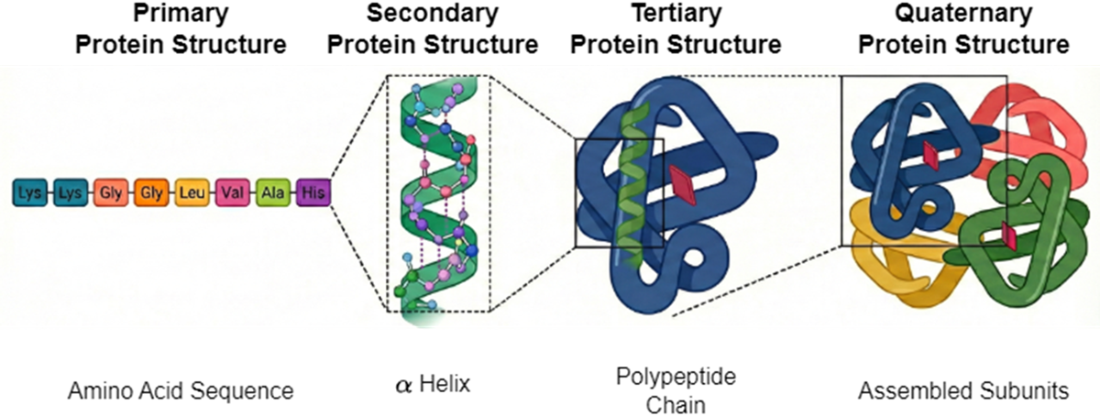
Use the structure hierarchy to distinguish an alpha-helix from the amino-acid sequence that encodes it and the complete three-dimensional fold it helps form. section 12.1.1
