The amnesiac coder issue appears when an AI coding agent treats each request as isolated and loses earlier decisions, fixes, interactions, or code context during a long task. Retrieval-augmented generation can find relevant information, but it does not provide continuity across steps. section 3.5.2 section 3.5.2
Typical symptoms include:
- Reintroducing errors that were already fixed. section 3.5.2
- Contradicting established design choices or requiring repeated requirements and context. section 3.5.2
- Drifting as the sliding token window fills with prompts, diffs, error messages, corrections, and rationales. section 3.5.2
The failure is structural: once earlier context falls beyond the window, it vanishes. Appending every interaction can also crowd out useful information, producing long-session context rot. Continuity therefore requires explicitly built, persistent, structured memory rather than retrieval alone. section 3.5.2 section 3.5.2
Figure 3.8 Tools like Cline allow you to track current context window fulfillment.
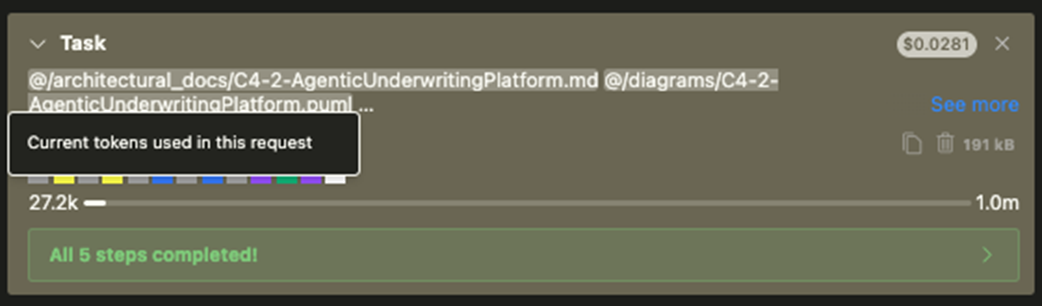
A context-window fulfillment view helps operators see when accumulated history is crowding out usable context. section 3.5.2
