Amortized variational inference replaces separate approximate-posterior parameters for each observation with a shared parameterized function. For an observation x and latent variable z, a neural network can map x to the mean and variance of an approximate posterior for z. Training adjusts the network parameters rather than a separate parameter set for every x. section 11.2
The shared mapping changes how inference is carried out:
- It lets observations use a learned inference function instead of requiring separate parameter optimization. section 11.2
- Its generalization gap depends on the capacity of the chosen neural network. section 11.2
Neural-network parameterization
A variational autoencoder uses an encoder to map an observation to latent-distribution parameters. A related application uses a multilayer perceptron in a mixture density network to parameterize a Gaussian mixture model. The mixture model illustrates neural parameterization; it should not be confused with the approximate posterior in every amortized-inference setup. section 11.2 section 11.7
Figure 11.6 A simple Bayesian network. Query 1 is a subquery of query 2.
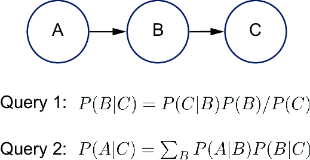
The Bayesian-network figure shows one query nested within another, illustrating the motivation to reuse earlier inference when answering a related query. section 11.2
