An analyst examines data to discover and communicate patterns, trends, and insights that inform decisions. The role combines mathematical, programming, business, and communication skills. section 1.1 section 1.0
Analysts translate organizational questions into measurable items, select appropriate methods, prepare data, and report findings as recommendations. Their work also includes clarifying ambiguity, managing expectations, and communicating timelines. section 2.1 section 1.3.1
Common responsibilities include:
- Apply descriptive statistics, inferential statistics, statistical models, financial models, or field-specific approaches. section 1.1
- Choose suitable tests, justify hypotheses, and build high-value datasets rather than relying only on technical execution. section 1.3
- Prepare and structure data, often spending substantial effort making messy or non-tabular data usable for analysis. section 11.1
- Support stakeholders across functions while balancing routine deliverables, ad hoc requests, deadlines, and business value. section 1.3.1
Demonstrating value
A startup analyst supports marketing, fundraising, programs, and human resources. As leadership requests increase, the analyst team must explain turnaround delays and show the expected value of additional headcount. section 1.3.1
Figure 2.1 Flowchart of an analytics lifecycle, looking at the effect of a customer education and outreach program. Each step distills the question into measurable items that can be analyzed and used to produce actionable recommendations.
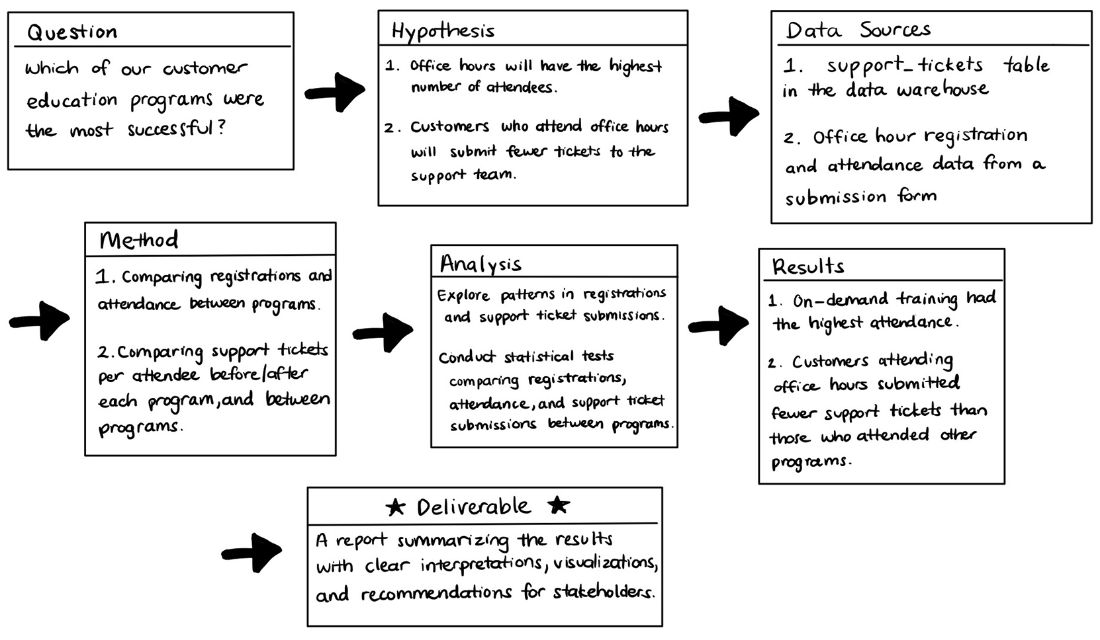
Follow the analytics lifecycle from a customer education and outreach question through measurable analysis and actionable recommendations. section 2.1
