Cohesion measures whether a software unit’s responsibilities belong together and support one clear purpose. A cohesive class or method does one thing, making the code easier to understand, test, and maintain. section 2.1
Small units make testing a design choice: developers can exercise one piece of business logic in isolation or test several pieces together. When behavior remains in one large unit, that choice disappears. section 2.1
Use cohesion as a practical guide while code evolves:
- Build complex behavior from smaller methods or classes, each with a focused responsibility. section 2.1
- Move new complexity to a separate location instead of continually extending an existing class. section 2.3
- Move complex business rules into their own class and break large business flows into multiple steps. section 2.3
- Treat small units as a straightforward starting rule, then refactor when a class or method proves insufficiently cohesive. section 2.3.2
A growing business flow
When a class accumulates business rules and an increasingly long workflow, separate the rules into their own class and divide the flow into smaller steps. For highly complex workflows, domain events or an event-based system may fit; otherwise, prefer simpler mechanisms. section 2.3 section 2.3.2
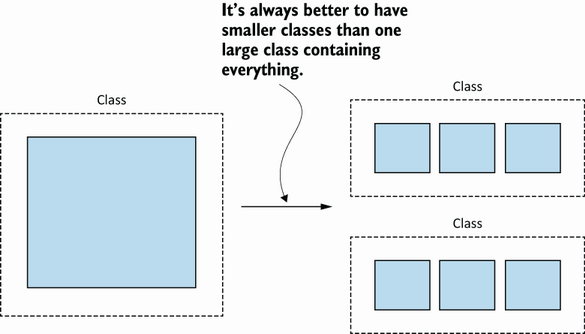
Use the figure to compare large units with smaller, focused units. section 2.1
