API-first architecture designs the service interface before building user interfaces or developer tools on top of a capability. Every platform capability, integration, feature, and automation should expose an API, whether it is purchased or built. This creates sustainable self-service experiences and clear boundaries between platform teams. section 1.3.3
Apply the pattern by making the interface the stable starting point:
- Define an API for every capability before selecting or building its user interface. section 1.3.3
- Expose purchased capabilities through APIs as well as internally built services. section 1.3.3
- Preserve boundaries and the ability to change as integrations and architectural decisions evolve. section 1.3.3 section 3.5.4
A self-service platform capability
A platform team defines a capability’s API first, then adds a self-service interface or developer tool that consumes it. The same interface supports collaboration across team boundaries and allows the implementation to evolve without replacing every consumer. section 1.3.3
Figure 1.5 Software defined is placed in the middle because it is a core attribute of everything the platform engineer delivers. The rest of the principles share a connection because they continuously evolve, and decisions made in applying these surrounding principles can affect the requirements of the others.
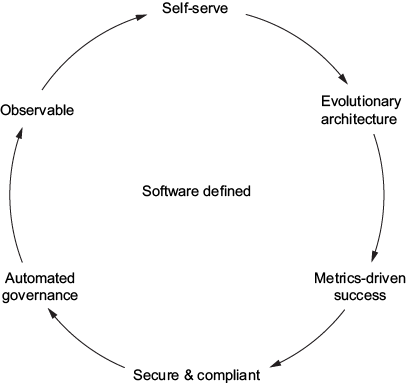
Use the figure to place API-first design within the broader relationship between software-defined delivery, self-service, evolutionary architecture, and measurable platform outcomes. section 1.3.3


