API sprawl is the uncontrolled proliferation of separate interfaces with fragmented conventions and access patterns. It emerges when teams independently expose workflows through different URLs, authentication mechanisms, response formats, documentation practices, and error-handling strategies. Shared platform infrastructure then provides little value: every consumer must write custom integration code for each workflow. section 2.3.1
Recognize API sprawl through its integration symptoms:
- Consumers maintain several base URLs and workflow-specific integration code. section 2.3.1
- Authentication varies between API keys, OAuth2, and custom JWT tokens. section 2.3.1
- Response formats, error handling, conventions, and documentation differ between workflows. section 2.3.1
- A change to one workflow’s access scheme becomes a coordination project across consuming applications. section 2.3.1
Prevent API sprawl by exposing workflows through standardized domain structures. A shared API Gateway provides a single external entry point, centralizes authentication, rate limiting, TLS termination, health checking, and load balancing, while explicit configuration preserves control over workflow-specific API paths. HTTP supports external clients across browsers, mobile applications, and backend services. section 2.6 section 2.6
A fragmented workflow platform
A patient assistant uses `healthcare-ai.company.com/api/v1/patient/assistant` with API-key authentication, a content generator uses `content-generator.company.com/generate/v2` with OAuth2, and document analysis uses custom JWT tokens. A unified dashboard must integrate all three as separate systems. section 2.3.1
Figure 2.3 API sprawl emerges when workflows expose inconsistent interfaces. In this example of the antipattern, 3 developer applications must each maintain custom integration code for every workflow they use, creating a tangled web of connections. Each workflow has its own authentication mechanism, response format, and conventions, forcing application developers to treat each workflow as a unique integration project rather than accessing a unified platform.
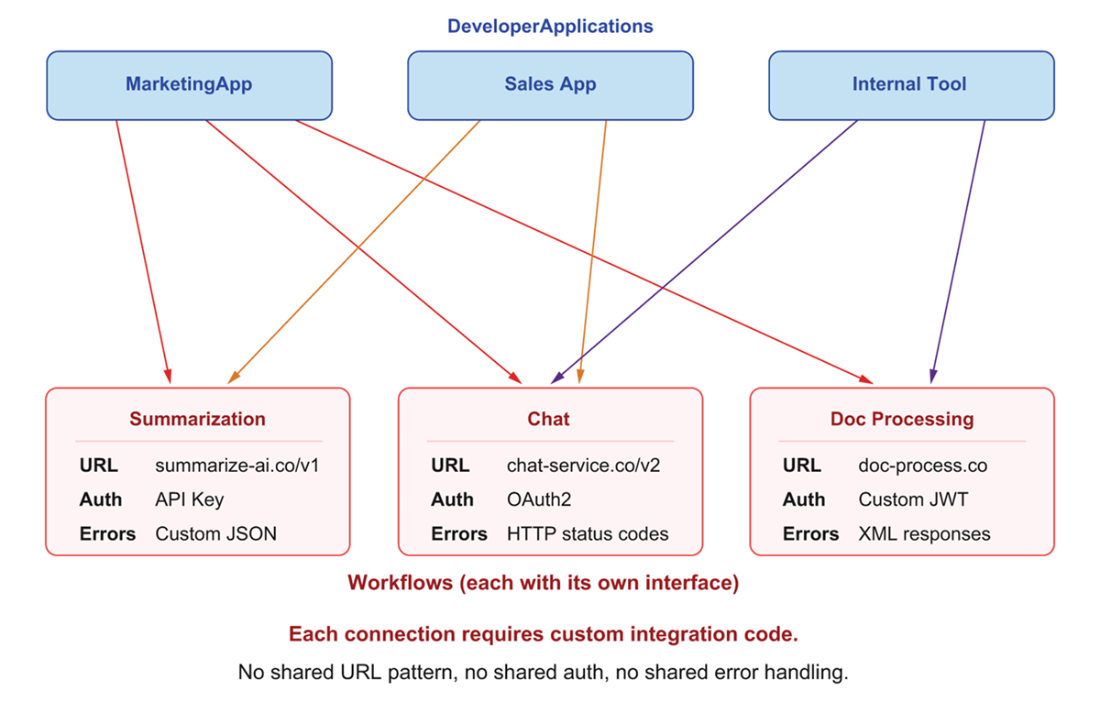
Use the figure to inspect how several developer applications form a tangled connection network when every workflow exposes different authentication, response, and integration conventions. section 2.3.1

