liveBook · Manning

Application fraud

As explained in Financial AI in Practice

Application fraud is fraud committed by providing deceptive information when applying for a financial product or service.

Application fraud occurs when someone provides false information at the point of origination to gain approval for a financial product or service. section 7.2

Examples include:

  • Falsifying income on a loan application. section 7.2
  • Misrepresenting risk factors to obtain lower insurance premiums. section 7.2
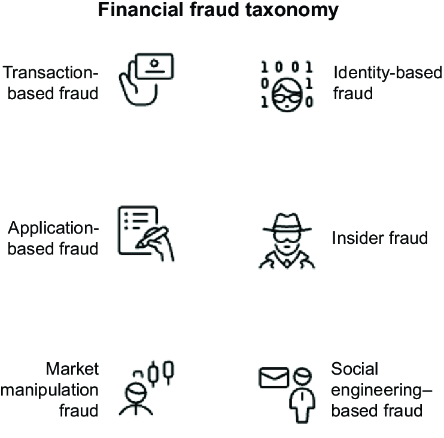
Figure 7.2 A structured typology of financial fraud. This framework organizes fraud into six primary categories based on the core attack vector, such as exploiting a transaction, compromising an identity, or deceiving a person. This structured view is crucial for developing specific and effective AI-driven countermeasures for each type of threat.
figure

See how application fraud fits among six financial fraud categories organized by attack vector. section 7.2

How Financial AI in Practice covers it

How deep it goes
Defines the category and gives loan and insurance examples, without detailing detection methods.
Examples
Uses falsified loan income and misrepresented insurance risk factors as examples.
What you can do after
Evaluate fraud risks by distinguishing deceptive origination applications from other attack vectors.
How it connects
Distinguishes application fraud from transaction-based, identity-based, internal, market manipulation, and social engineering fraud.

This explainer was generated by Manning's knowledge graph from the text of Financial AI in Practice. The section links point to the parts of the book it draws on.