liveBook · Manning

Application frontend

As explained in Rust Servers, Services, and Apps

A user-facing application component, such as a mobile or browser-based interface, that communicates with remote backend services.

An application frontend is the user-facing component of a distributed application. It may be a mobile app on iOS or Android or a web frontend running in an internet browser. section 1.1

Application frontends perform three connected roles:

  • Present the interface with which end users interact. section 1.1
  • Communicate with application backend services deployed on remote servers, data centers, or cloud platforms. section 1.1
  • Use backend APIs to complete tasks on behalf of users, while business rules, database access, computation, and integrations remain backend concerns. section 1.1

Typical frontend forms

A mobile application running on iOS or Android and a browser-based web frontend are application frontends; both communicate with remote application backend services. section 1.1
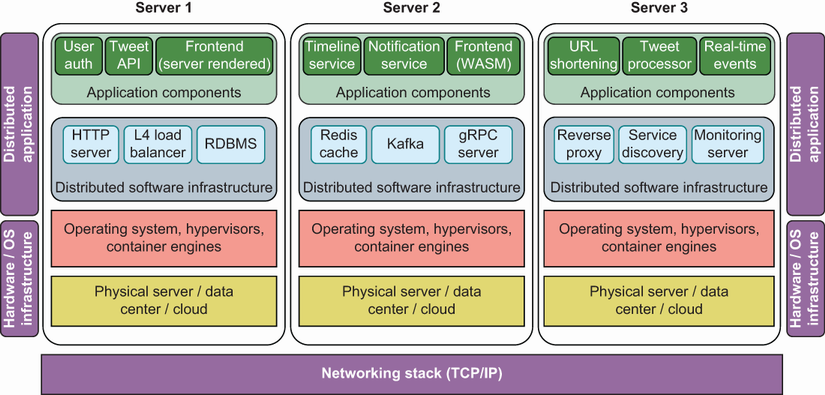
Figure 1.1 A simplified distributed systems stack for a social media application

Use the distributed-systems stack diagram to locate the application frontend alongside backend services and supporting infrastructure. section 1.1

How Rust Servers, Services, and Apps covers it

How deep it goes
Defines frontend platforms and responsibilities but stops short of implementation details, interface code, and deployment procedures.
Examples
Uses iOS and Android mobile apps, browser frontends, and a social media distributed-systems stack.
What you can do after
Evaluate/understand where user interaction and API communication fit within a distributed application architecture.
How it connects
Connects application frontends to application backends, APIs, HTTP, REST, gRPC, GraphQL, and distributed software infrastructure.

Related concepts

This explainer was generated by Manning's knowledge graph from the text of Rust Servers, Services, and Apps. The section links point to the parts of the book it draws on.