Approximation represents a complex function, shape, or data set with a simpler one that is close enough for the task. A polynomial can replace a trigonometric function using only additions and multiplications, or reveal a trend without passing through every measured point. section 6.0 section 6.2
Choose the representation according to the required accuracy and purpose:
- Use approximation when capturing a general trend matters more than matching every data point. section 6.0
- Use interpolation when the function must pass exactly through specified points; this is valuable for joining geometric curves and surfaces without gaps. section 6.3
- Balance precision against computation and storage: a coarse model can be useless, while excessive precision can make processing impractical. section 11.2.2 section 11.2.3
A practical approximation
A processor can evaluate sine, cosine, logarithm, or exponent through polynomial substitutes. Increasing polynomial degree can improve precision, but changes the performance trade-off. For geometric models, the same principle appears when a smooth surface becomes a triangle mesh whose accuracy should match its eventual use, such as a 100-micrometer-accurate printer. section 6.2 section 11.2.2
Figure 6.18 When a polynomial approximates the data set with 0 error, every data point belongs to its graph.
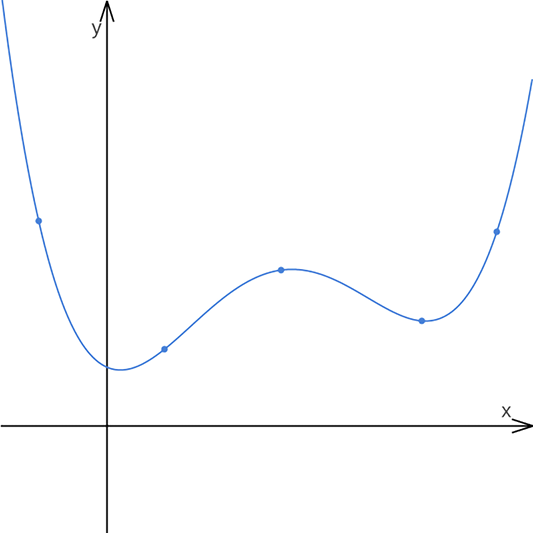
A zero-error approximation places every data point on the polynomial graph, making the distinction between ordinary approximation and interpolation immediately visible. section 6.3
