An architectural inventory is a source-backed list of the runtime programs and wires that make up a system. Build it from configuration files, then replace a flat parts list with an operational map: who wrote each component, who operates its machine, and what control remains when it fails. section 9.3
Classify each component across two ownership questions:
- CLIENT: your code on a machine you do not operate; ship updates but cannot control the device. section 9.3
- RUN: your code on your machine; edit the application and its environment. section 9.3
- RENT: vendor code on your machine; change configuration but not source. section 9.3
- CALL: vendor code on a vendor machine; retry, cache, or route around failures. section 9.3
A production-shaped map
A Cal.com inventory groups thirteen nodes into one CLIENT browser, four RUN nodes, two RENT stores—Postgres and Redis—and six CALL services. Solid arrows show synchronous edges; dashed arrows show asynchronous work through the tasker queue. section 9.3
Figure 9.5 The four machine-ownership bands dictate your control. CLIENT: Your code on a machine you do not operate, letting you ship updates. RUN: Your code on your machine, where you can edit anything. RENT: Vendor code on your machine, limiting you to config changes. CALL: Vendor code on a vendor machine, where you can only retry, cache, or route around.
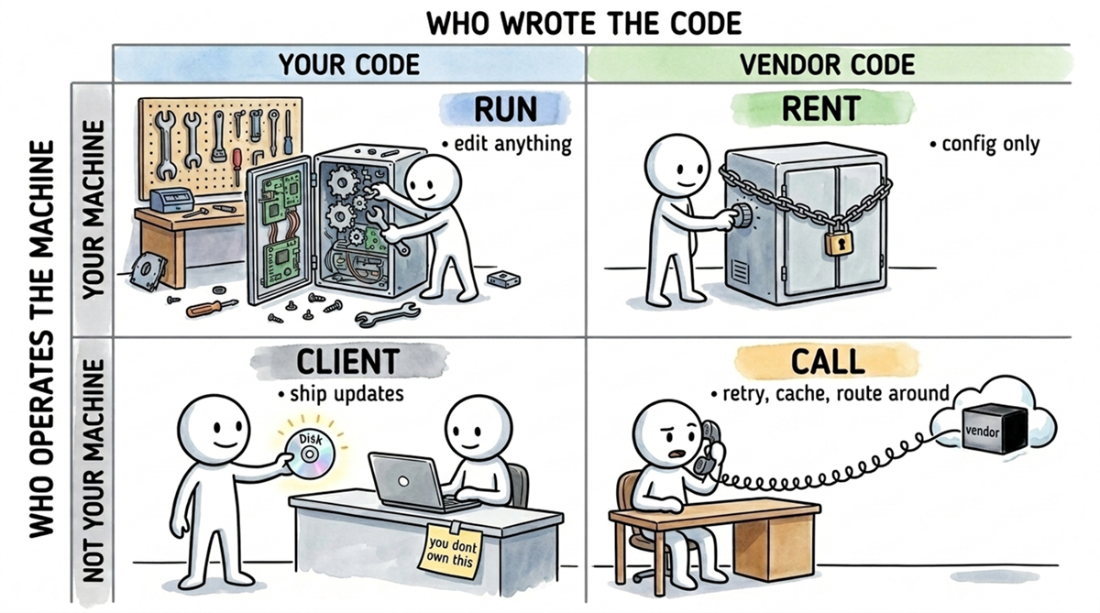
Use the four-band visual to connect ownership with practical control during outages. section 9.3
