liveBook · Manning

Architecturally significant scenario

As explained in Microservices Patterns, Second Edition

An architecturally significant scenario is a scenario that captures an application's essential behavior or imposes technical requirements that shape its architecture.

An architecturally significant scenario either captures an application's essential behavior or imposes technical requirements that shape its architecture. Scenarios describe how architectural elements collaborate to implement an operation or user story. section 3.2.5

Select scenarios that reveal the application's core behavior or important technical forces:

  • For a food-ordering application, ordering, preparation, and delivery express the essential flow. section 3.2.5
  • For other systems, prioritize scenarios involving large data volumes or stringent performance requirements. section 3.2.5
  • Choose collaborating elements according to the view: classes or subdomains, components, or infrastructure elements. Scenarios can span views. section 3.2.5
Figure 3.12 A sequence diagram for the createOrder() operation that shows how the API Gateway, Order Service, Consumer Service, and Kitchen Service collaborate to implement the operation
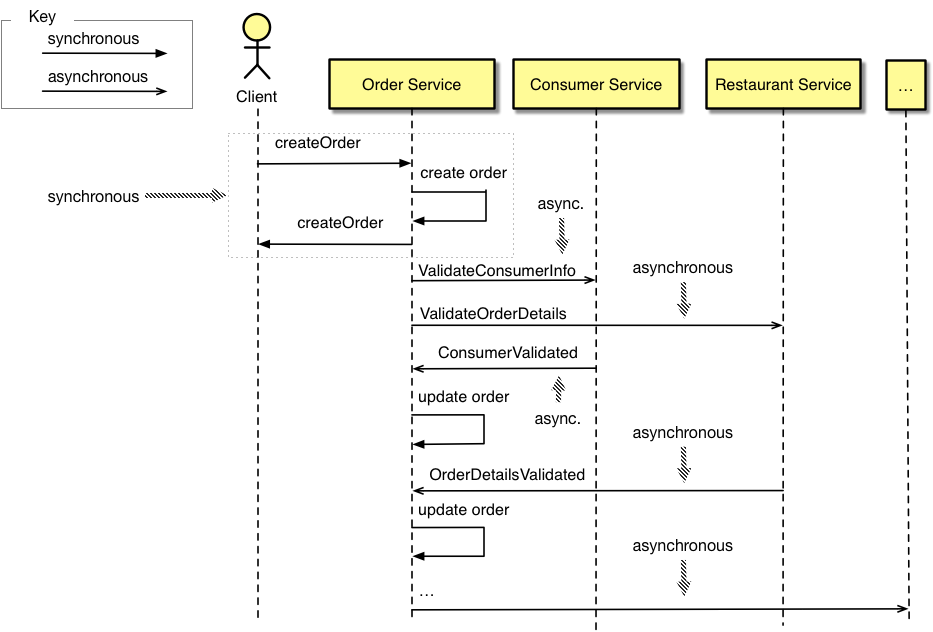
self contained order taking

A sequence diagram traces how the API Gateway, Order Service, Consumer Service, and Kitchen Service collaborate on createOrder(). section 3.2.5

How Microservices Patterns, Second Edition covers it

How deep it goes
Defines selection criteria and relates scenarios to collaborating elements across domain, component, and deployment views.
Examples
Uses food ordering, preparation, and delivery, plus data-intensive or performance-critical scenarios and a createOrder() sequence diagram.
What you can do after
Evaluate architecture priorities by identifying scenarios that express core behavior or impose technical constraints.
How it connects
Connects user stories and system operations to domain, component, and deployment views, and visualizes interactions with sequence diagrams.

Related concepts

This explainer was generated by Manning's knowledge graph from the text of Microservices Patterns, Second Edition. The section links point to the parts of the book it draws on.