Graph traversal visits related nodes through defined edges. In a search knowledge graph, it connects terms, queries, document fields, and categories by following relationships discovered through search indexes. section 5.2 section 5.4.3
Each edge combines inverted-index and forward-index lookups: one direction finds documents for terms, while the other finds terms in documents. Chaining these lookups enables multilevel traversal. Because some paths are more relevant than others, relationship scores and weights prioritize edges during traversal. section 5.4.3
Traversing skills to job titles
Starting at the skill node Java, a traversal can reach related skills such as Hibernate and Scala, then continue to job-title nodes such as Software Engineer, Data Scientist, and Java Developer. Oncology remains disconnected when no documents create an overlapping path. section 5.4.3
Disambiguating query meaning
A two-level traversal first maps an ambiguous query to a category, then finds related terms within that category. For server, the devops path yields terms such as Docker and Nginx, while the cooking path yields restaurant and dish-related terms. The operation can be configured with context and keyword fields, limits, and minimum occurrence thresholds. section 6.2
Figure 5.4 Inverted index and forward index. Documents get added to an inverted index, which maps documents to lists of terms, and to a forward index, which maps terms back to lists of documents. Having the ability to map both directions will prove important for graph traversal and relationship discovery.
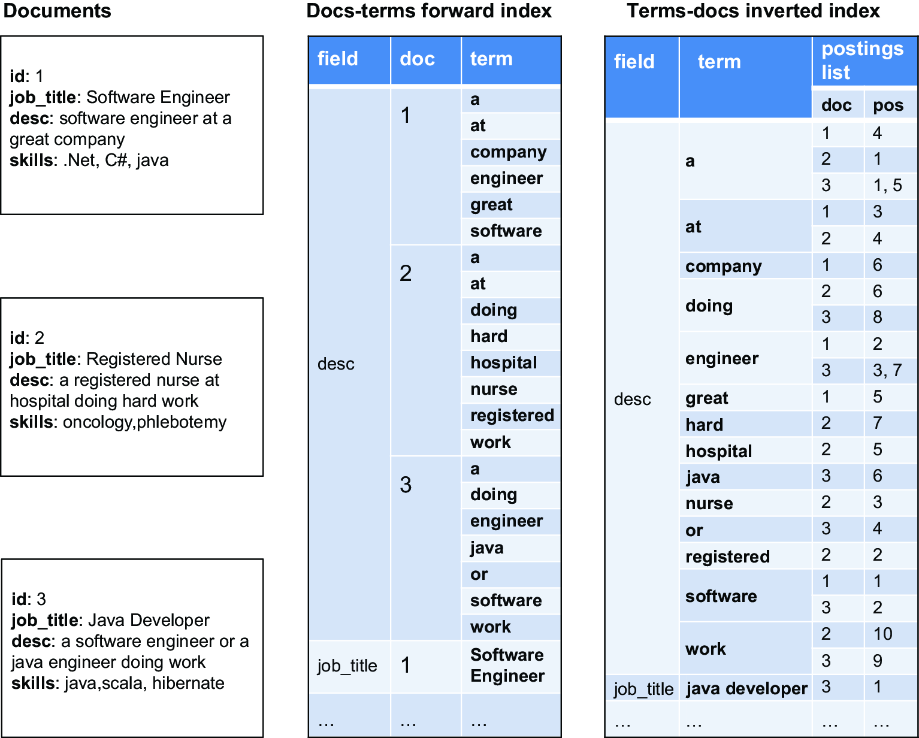
Use the index-direction diagram to trace how document-to-term and term-to-document mappings support relationship discovery. section 5.4.3


