liveBook · Manning

Artifact store

As explained in Designing Deep Learning Systems: A guide for software engineers

A storage system for versioned files and objects produced or consumed by machine learning workflows.

An artifact store retains datasets, model files, and model versions produced by training experiments so they remain persistent and retrievable for serving and analysis. section 8.0 section 6.1.3

A model-serving workflow assigns the store and its neighboring components distinct responsibilities:

  • The artifact store holds models produced by model training. section 6.1.3
  • The prediction web API receives prediction requests. section 6.1.3
  • The prediction service loads a model from the store into memory or a GPU, executes it, and returns the result. section 6.1.3

Beyond serving, persistent artifact and metadata retrieval supports model reproduction, experiment comparison, model selection, and investigation of model degradation. section 8.0
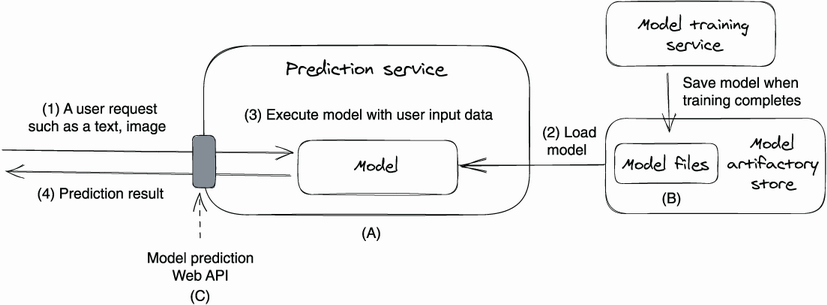
Figure 6.3 A typical model prediction workflow in a prediction service

Use the workflow diagram to trace requests from the prediction API through model loading and execution. section 6.1.3

How Designing Deep Learning Systems: A guide for software engineers covers it

How deep it goes
Explains persistence, retrieval, model loading, component responsibilities, and store design principles, while introducing ML Metadata and MLflow.
Examples
Uses datasets, model files, model versions, training metrics, and a shark-detection prediction service.
What you can do after
Diagnose/debug with it by reproducing models, comparing experiments, selecting candidates, and investigating model degradation.
How it connects
Connects model training, model serving, metadata management, experiment comparison, and troubleshooting.

Related concepts

This explainer was generated by Manning's knowledge graph from the text of Designing Deep Learning Systems: A guide for software engineers. The section links point to the parts of the book it draws on.