Artificial general intelligence (AGI) refers to human-level or broad intellectual capability: adapting to novelty, handling uncertainty, and efficiently acquiring skills across previously unseen tasks. section 1.10 section 19.3.3
A system that excels at one fixed task is not necessarily generally intelligent. Supplying more task-specific data or rules can increase performance without increasing generalization; a small change may require retraining or rebuilding. section 19.3.3
Chess skill versus general intelligence
Deep Blue’s alpha–beta search defeated chess opponents, but it was not a model of the human brain and did not generalize beyond similar board games. Chess illustrates why solving a specific task can be easier than building an artificial mind. section 19.3.3
Figure 19.8 A low-generalization system can achieve arbitrary skill at a fixed task given unlimited task-specific information.
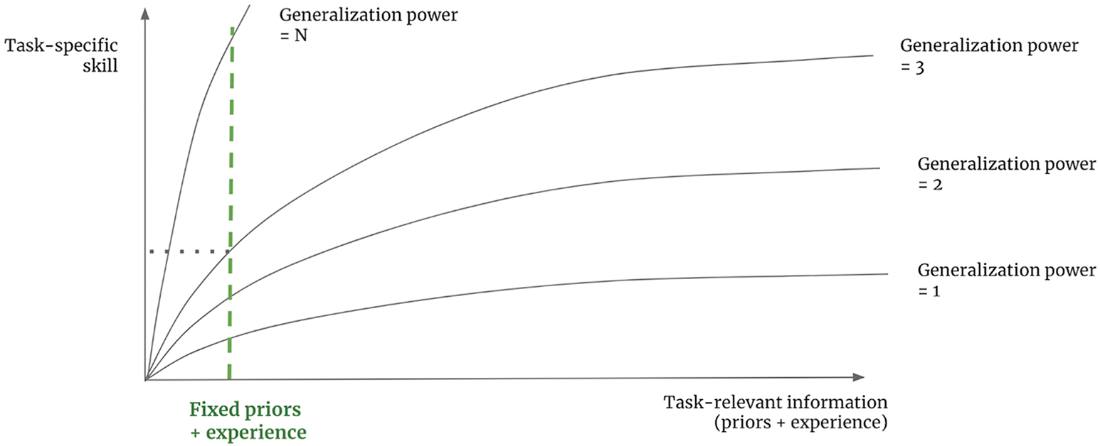
This figure shows how unlimited task-specific information can produce arbitrary skill on a fixed task while leaving generalization low. section 19.3.3
Predictions of imminent AGI have repeatedly accompanied periods of intense AI optimism. As of 2025, human-level general intelligence still appears far away, with no reliable timeline for its arrival. section 1.10 section 1.11



