An assumption check tests whether a model’s expected prediction, bias, and residual behavior is supported by data. Unexpected patterns can motivate different models, more data, or better features. section 9.2.2
For linear regression, check these assumptions:
- Linearity between predictors and the target. section 9.2.2
- Strict exogeneity, expressed as zero-centered residuals. section 9.2.2
- Normally distributed residuals. section 9.2.2
- Constant residual variance across predictor values. section 9.2.2
- Independent residual error terms and no highly influential observations. section 9.2.2
Demand forecasting
After fitting a linear regression for demand forecasting, inspect residuals with diagnostic plots. Patterns, biased residuals, changing variance, or influential points indicate that the model or its inputs need reconsideration. section 9.2.2
Figure 9.10 Four diagnostic plots for linear regression’s residual analysis in both cases (Case 1: Assumptions are met)
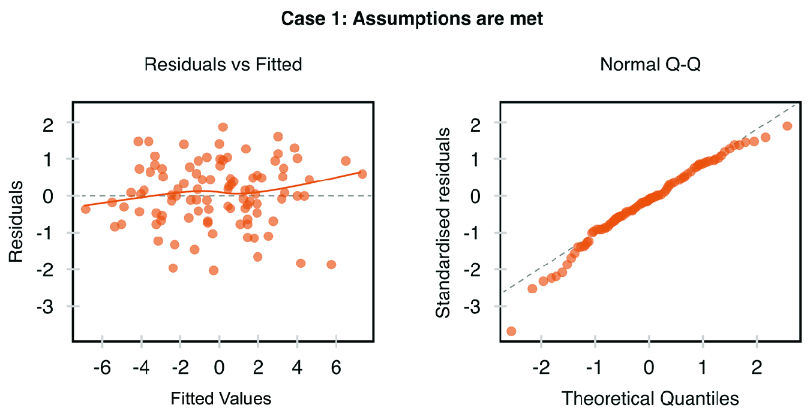
Compare four residual diagnostic plots for a case where the linear-regression assumptions are met. section 9.2.2
