Asynchronous request/response lets a client send a service request without waiting for an immediate reply. Unlike synchronous request/response, it does not require the client to block while the service processes the request. section 8.1.1 section 8.3
When implemented with messaging, the exchange works as follows:
- The client sends a command containing the operation and parameters to a point-to-point channel owned by the service. section 8.3.2
- The request identifies a reply channel; the service sends the outcome there with a correlation ID that lets the client match the reply to its request. section 8.3.2
- The client normally handles replies asynchronously, though it could block until a reply arrives. Messaging alone does not guarantee that a client avoids blocking. section 8.3.2
Create Order saga
An Order Service orchestrator sends commands to saga participants and receives their replies through message channels. This applies asynchronous request/response to coordinate a multi-step system command while maintaining responsiveness. section 11.4 section 11.1.2
Figure 8.13 Implementing asynchronous request/response by including a reply channel and message identifier in the request message. The receiver processes the message and sends the reply to the specified reply channel.
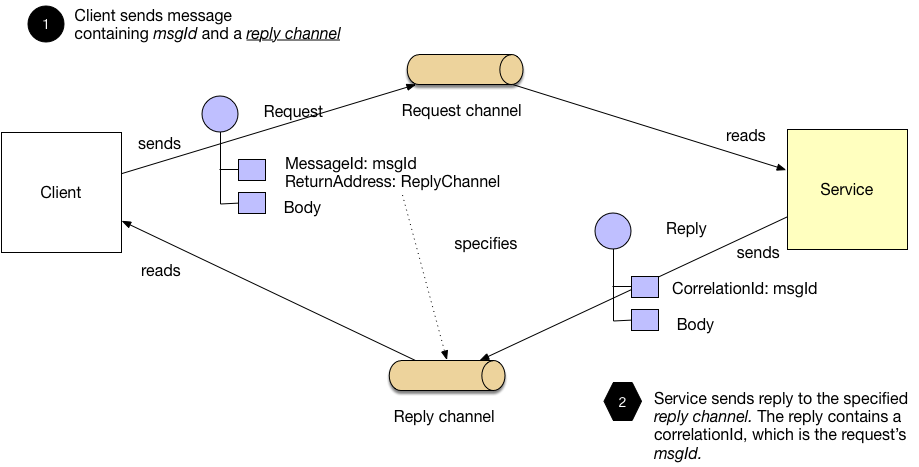
Use the message-flow diagram to see how a request supplies a reply channel and message identifier for the response. section 8.3.2

