Asynchronous training separates rollout generation from policy optimization. Actor systems generate answers while a learner takes policy-gradient steps, so the two sides can run concurrently and may temporarily hold different model weights. This replaces a synchronized generation-update rhythm with a pipeline fed by completed rollouts. section 6.3.3 section 6.6
The arrangement targets a throughput problem in long-horizon reasoning RL: completion lengths can vary sharply, including very long outliers, leaving compute idle while a synchronized batch waits. Asynchronous updates let training consume recently completed rollouts from multiple generating instances instead of waiting for every rollout to finish. section 7.3.3 section 6.3.3
A practical asynchronous pipeline has these responsibilities:
- Actors try to solve problems and emit completed rollouts; learner workers consume them for policy-gradient updates. section 6.3.3
- Queues pass rollout data between actor and learner GPUs, allowing generation and learning to proceed independently. section 6.3.3
- Weight synchronization refreshes actor parameters from the learner; longer intervals can support scaling across multiple data centers. section 6.3.3
- Off-policy correction must address the distribution mismatch created when rollouts were generated under different weights than the learner's current policy. section 6.6
Actor–learner flow
Several actor instances finish reasoning rollouts at different times and place them in a data queue. The learner fills an update batch from the newest completed items, takes gradient steps, then periodically synchronizes weights back to actors. Fast completions need not wait for a long outlier, but the learner must account for the resulting off-policy data. section 6.3.3 section 7.3.3 section 6.6
Figure 6.8 A comparison of the generation-update phases for synchronous or asynchronous RL training, following Noukhovitch et al. (2024)
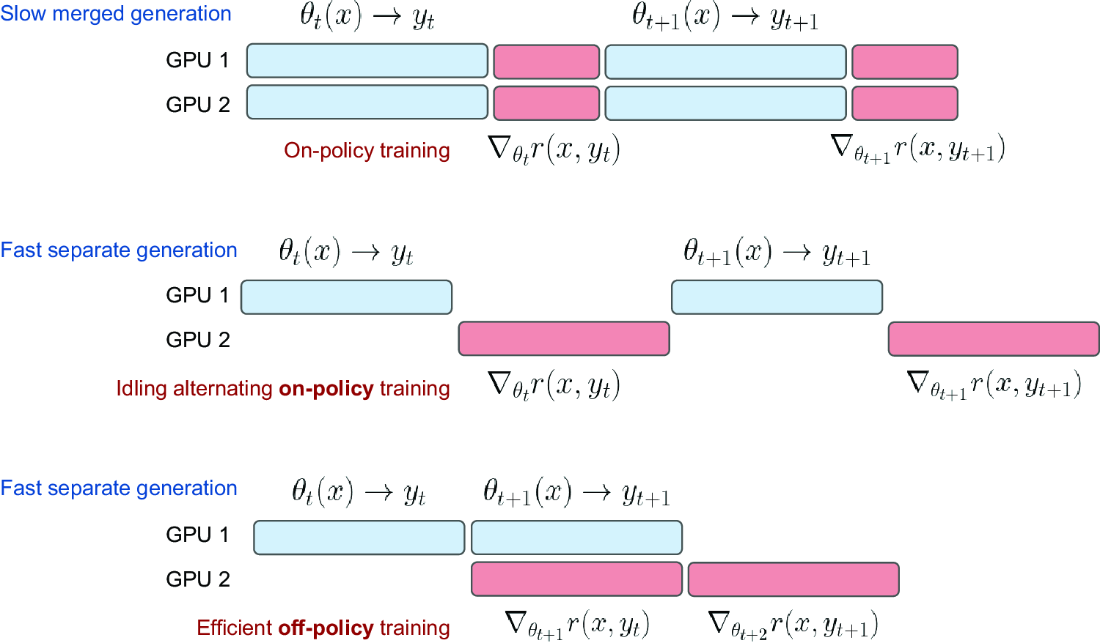
Compare synchronized generation-update phases with an asynchronous pipeline to see where concurrent work removes waiting. section 6.3.3
Figure 6.9 An example distributed RL system where two queues are managed to pass data to the learner and actor GPUs, which can both be synchronized with a distributed computing library such as Ray. Olmo Team 2025, license CC-BY.
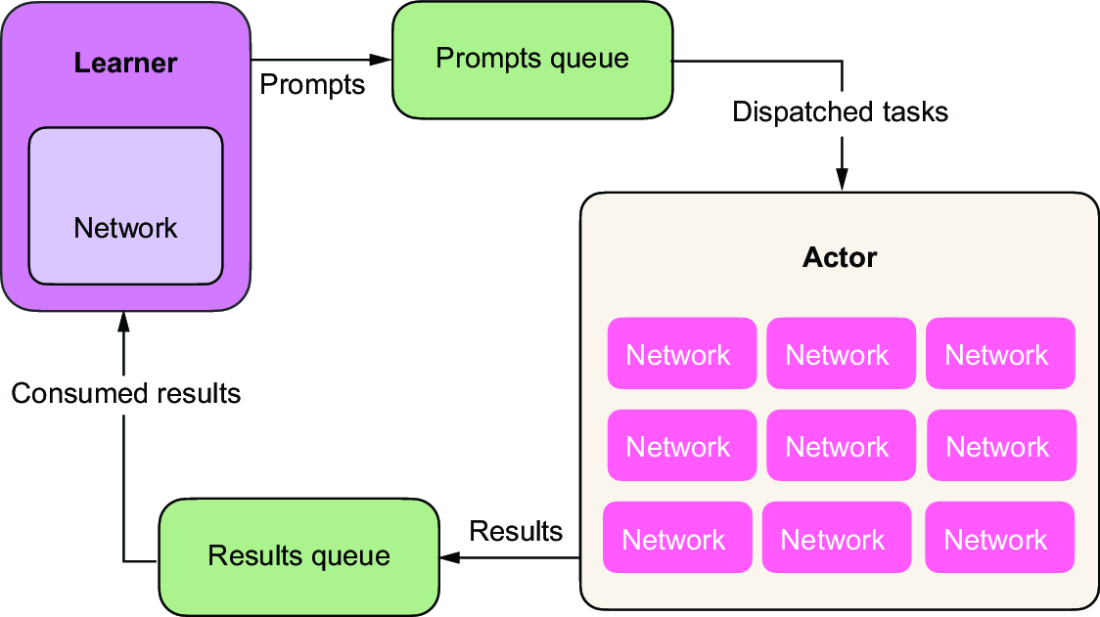
Inspect a distributed layout with rollout queues connecting actor and learner GPUs, including synchronization through a distributed computing library. section 6.3.3
