A single retrieval call can miss part of a multi-part question. An atomic query isolates one information need so it can be retrieved, answered, and checked without treating the whole request as one search. In LevelRAG, a High-Level Searcher plans these queries before retrieval; Low-Level Searchers execute them. section 11.3.1 section 11.6
Comparing compliance requirements
For “Compare enhanced due diligence requirements for domestic PEPs in the UK versus the EU under the latest 2025 guidance,” the planner asks separately for UK requirements and EU requirements. If a UK document cites FCA guidance FG25/3, it can add a third query for that identifier. The third query is planning based on retrieved evidence, not merely splitting the original sentence. section 11.3.1
The queries move through a verify-and-supplement loop:
- Assign each query a retrieval task. The illustrated Python representation stores its text, rationale, and a sparse, dense, or web tool choice. section 11.3.3
- Retrieve documents and answer each atomic query from its own results. Query-specific summaries keep the combined context compact while retaining facts needed for the original answer. section 11.3.1
- Check whether the summaries together answer the original question. If not, generate queries for missing information; stop when evidence is sufficient or an iteration limit is reached. section 11.3.3
Figure 11.6 Solving the Compliance Scenario: How LevelRAG decomposes a complex query into atomic research tasks.
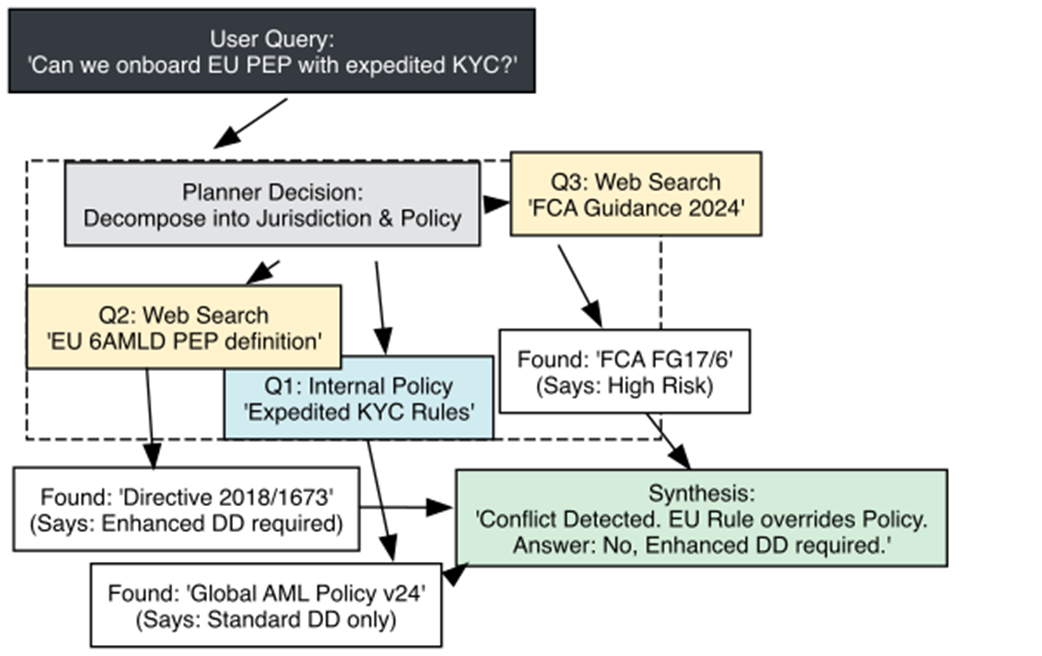
The compliance diagram shows how one comparison becomes distinct research tasks. section 11.3.1
Listing 11.5 The LevelRAG engine with verify-and-supplement loop.
class LevelRAGEngine:
    def __init__(self, hls: HighLevelSearcher,
                 low_level_searchers: dict, max_iter: int = 3):
        self.hls = hls
        self.searchers = low_level_searchers  #A
        self.max_iter = max_iter

    def execute(self, user_query: str) -> List[str]:
        summaries: List[str] = []
        pending = self.hls.decompose(user_query)
        for iteration in range(self.max_iter):
            for atomic in pending:  #B
                searcher = self.searchers.get(
                    atomic.tool, self.searchers['dense'])
                docs = searcher.retrieve(atomic.text)
                summary = self.hls.summarize(atomic, docs)
                summaries.append(
                    f"[{atomic.tool.upper()}] {atomic.rationale}\n{summary}"
                )
            verdict = self.hls.verify(user_query, summaries)  #C
            if verdict.sufficient:
                return summaries
            pending = self.hls.supplement(verdict.missing)  #D
            if not pending:
                break
        return summaries  #E
The engine listing shows query dispatch, per-query summarization, and the bounded verification loop. section 11.3.3
Atomic queries cost more than a single-pass search when planning and verification require several model calls. The illustrated implementation routes each query to one chosen searcher; the original LevelRAG approach runs each through all Low-Level Searchers. For simpler questions, a single-pass path or CRAG-style post-retrieval audit may be cheaper. In a composite pipeline, each atomic result can be audited independently and only a weak result sent to fallback search. section 11.3.3 section 11.4 section 11.5.3

