An ATP-binding pocket is the kinase binding-site cavity where ATP binds during catalysis. Because this site is highly conserved across kinases, inhibitors can bind unintended family members, making affinity and selectivity central drug-discovery concerns. section 8.1.1 section 13.3.1
The pocket matters in kinase drug discovery because it:
- Provides a well-defined site for competitive small-molecule inhibitors. section 13.3.1
- Creates an affinity–selectivity trade-off: conserved binding features can produce off-target activity across the kinase family. section 8.1.1
- Makes sequence differences within the pocket useful for designing more selective inhibitors. section 13.3.1
TNIK as a selectivity case
For idiopathic pulmonary fibrosis research, TNIK was considered druggable because its kinase domain offered an ATP-binding pocket. Sequence differences from other kinases suggested that selective inhibition might be achievable, reducing off-target risk even though no selective small molecule or ligand-bound crystal structure was available. section 13.3.1
Figure 8.2 Map of human protein kinases, i.e., the Manning kinome tree, clustered based on sequence similarity into eight major groups [3].
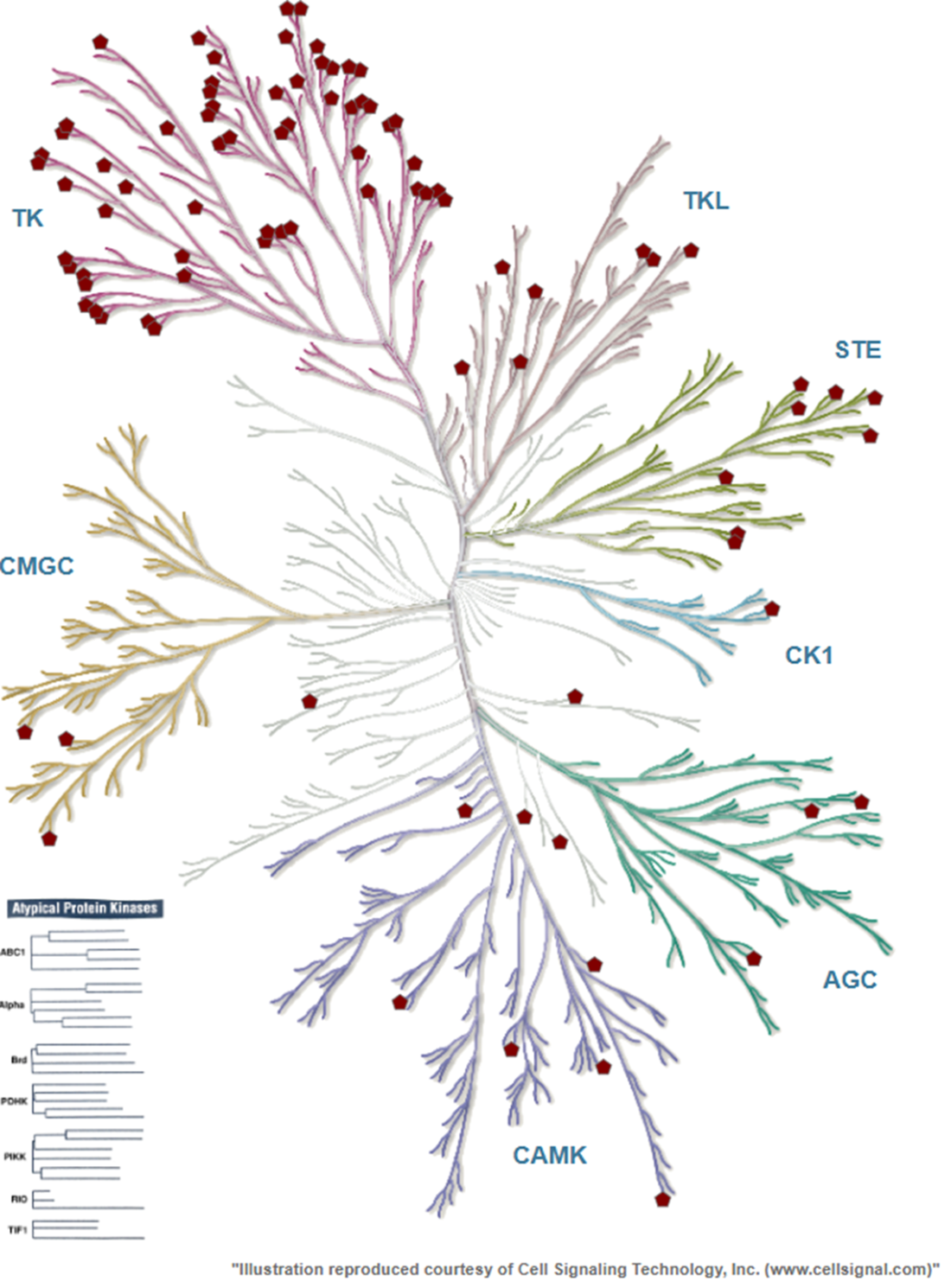
Use the kinome tree to place ATP-pocket targeting within the broader family of human kinases and its uneven landscape of approved drugs. section 8.1.1
