Audience activation turns defined first-party-data audiences into campaign-ready segments. It is the operational half of the process alongside audience design, which explores and defines inclusion and exclusion criteria. section 3.1.1
Manual activation creates a bottleneck: data teams repeatedly query first-party data while marketers manage requests instead of campaigns. Self-serve capabilities increase audience velocity by letting marketers work directly with understandable fields and receive immediate audience-size feedback. section 3.1.1
A practical activation capability typically supports:
- Selecting inclusion and exclusion criteria from clearly labeled first-party data fields. section 3.1.1
- Reviewing audience size immediately, with advanced analysis of attribute breakdowns, overlap, and aggregate metrics such as lifetime sales volume. section 3.1.1
- Moving from rapid activation to controlled experiments that identify winning audiences and measure incremental business impact. section 3.2
- Governing audience assignments when customers belong to many segments, reducing marketing saturation and fatigue while supporting customer lifetime value. section 3.2
From dashboard workaround to scalable activation
An analytics team can begin with a customized Tableau, Looker, or PowerBI dashboard listing common audience criteria. This short-term approach helps marketers build confidence in the data, but becomes harder to scale as first-party attributes multiply. A longer-term self-serve platform removes the recurring data-team bottleneck. section 3.1.1
Figure 3.1 A typical manual process for audience creation
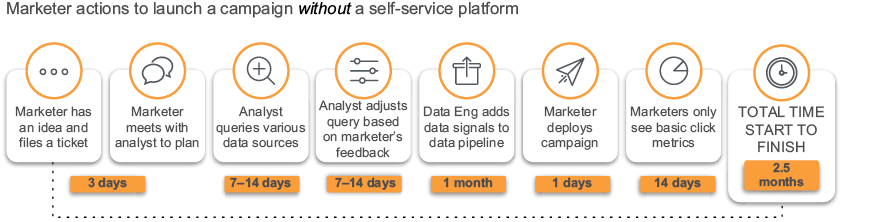
Use the manual-process figure to trace how repeated audience requests constrain campaign execution before self-serve activation. section 3.1.1
Figure 3.2 Campaign process flow shown side by side with a self-serve platform
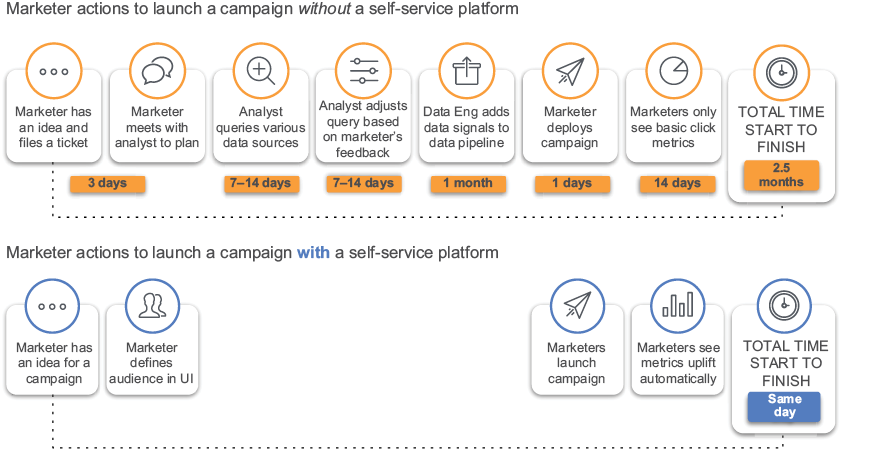
Use the side-by-side flow to compare conventional campaign execution with a self-serve audience platform. section 3.1.1
