An audit trail is a chronological record of system events and actions that supports accountability, investigation, and compliance reporting. In production AI systems, it makes safety decisions visible instead of leaving blocked requests, altered content, or permitted actions unexplained. section 6.8.2 section 1.3
Treat every guardrail evaluation as an auditable event, regardless of outcome. A record identifies the inspection point, policies checked, triggered policies, action taken, and—when relevant—confidence scores and content hashes. Restrict sensitive originals through encryption and access controls rather than omitting the evidence needed for review. section 6.8.2
Record the complete decision path:
- Hard stops capture the policy, reason, and user message so developers can debug failures and users can receive an explanation. section 6.8.2
- Silent modifications capture both original and modified content; store the original encrypted with restricted access for compliance review. section 6.8.2
- Pass-through evaluations still generate records confirming that policies were checked and passed. section 6.8.2
- Connect records to metrics such as outcome counts, latency, trigger rates, and error types to support policy tuning and operational monitoring. section 6.8.2
Tracing a blocked request
A support request reaches an input guardrail and is blocked. The audit record identifies the input inspection point, the policy that triggered, the reason, and the action. A rising block rate can then alert policy owners to investigate false positives or configuration defects. section 6.8.2
Figure 6.17 Comprehensive observability captures every guardrail evaluation to make safety decisions measurable and auditable. The platform generates a record for every interaction, regardless of the final outcome. If a request is explicitly blocked ("Hard Stop"), the system logs the exact policy, reason, and user message; if the rate of these blocks exceeds normal thresholds, it automatically alerts policy owners to investigate. For "Silent Modifications", where the system redacts or transforms content without interrupting the user—the logs safely capture both the original and modified text to enable compliance auditing and debugging. Finally, even fully permitted requests ("Pass Through") generate records confirming that all policies were checked and passed. Ultimately, all three paths feed into a centralized metrics pipeline used to tune policies and monitor system health.
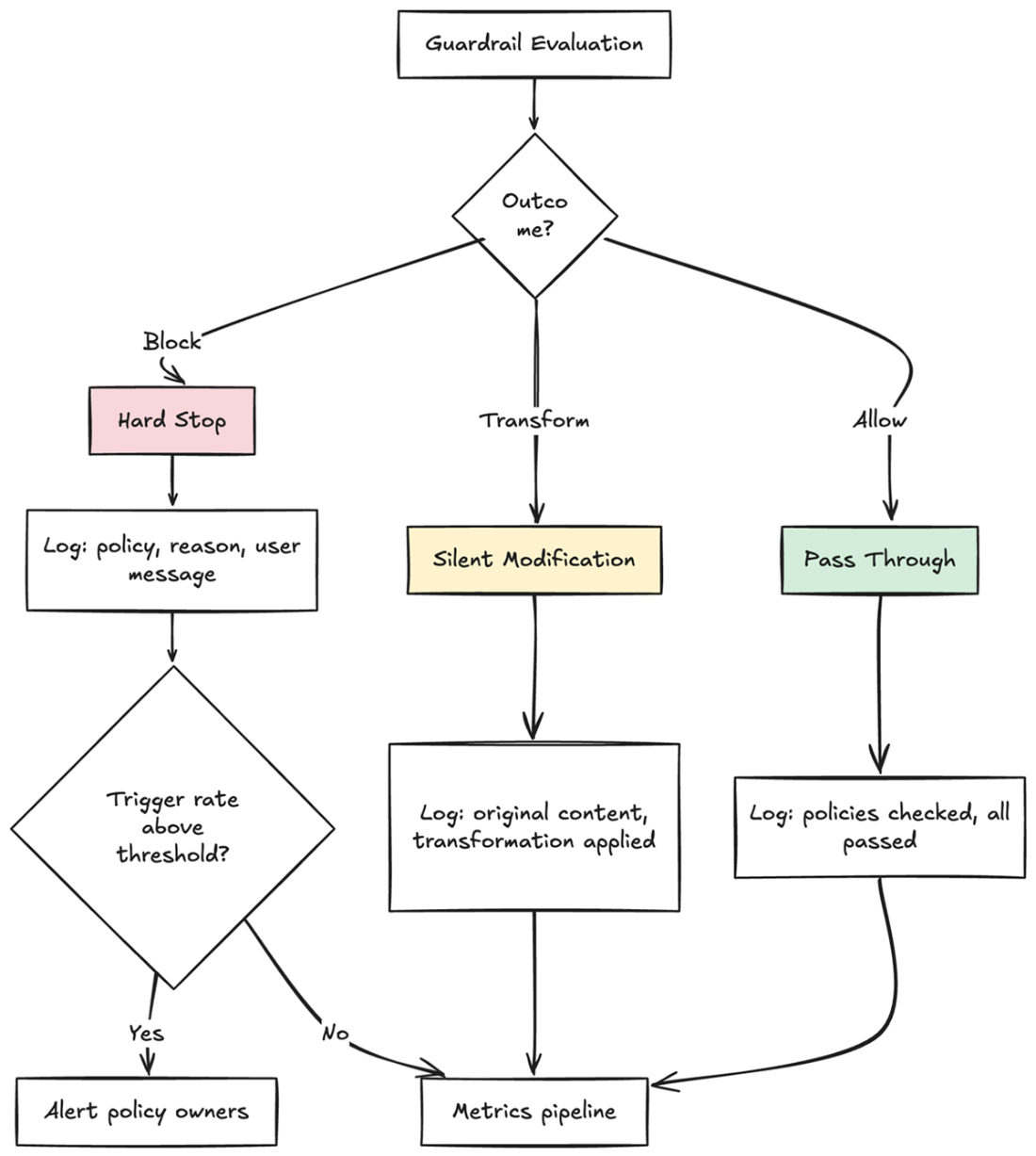
Use the observability diagram to compare hard stops, silent modifications, and pass-through evaluations as three auditable paths feeding centralized metrics. section 6.8.2