G-Retrieval is the online retrieval stage of graph-based RAG. Instead of returning independent top-k chunks through similarity search, it anchors a query to graph nodes and traverses connected edges to gather a coherent evidence subgraph. section 12.1.1
The workflow separates query grounding from evidence gathering: identify nodes named or implied by the query, then walk outward through relationships. This changes the context shape supplied to generation from disconnected passages to connected evidence. section 12.1.1
A typical G-Retrieval path consists of:
- Anchor the query to graph nodes representing entities or concepts. section 12.1.1
- Traverse relationships to collect connected passages or graph evidence. section 12.1.1
- Use the resulting subgraph as structured context for generation or ranking. section 12.1.1 section 12.3.2
Activation spreading in HippoRAG
For “Which Stanford professor works on Alzheimer's?”, HippoRAG extracts Stanford and Alzheimer's as seed nodes, then uses personalized PageRank to spread activation through the knowledge graph. The resulting connected evidence supports multi-hop retrieval rather than simple keyword matching. section 12.3.2
Figure 12.2 The same corpus and the same query, run through both workflows.
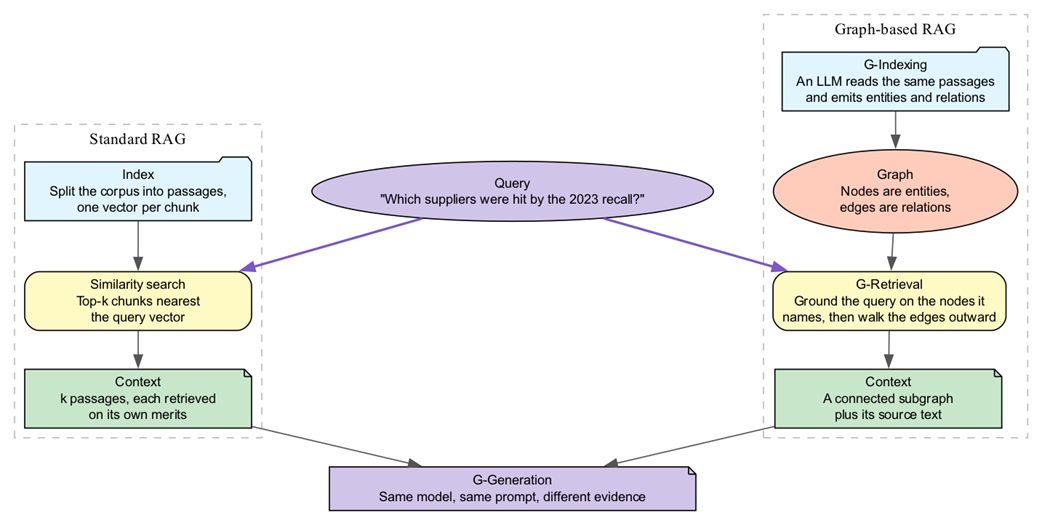
Compare standard RAG's independent top-k passages with graph-based RAG's node-grounded traversal and connected subgraph. section 12.1.1
