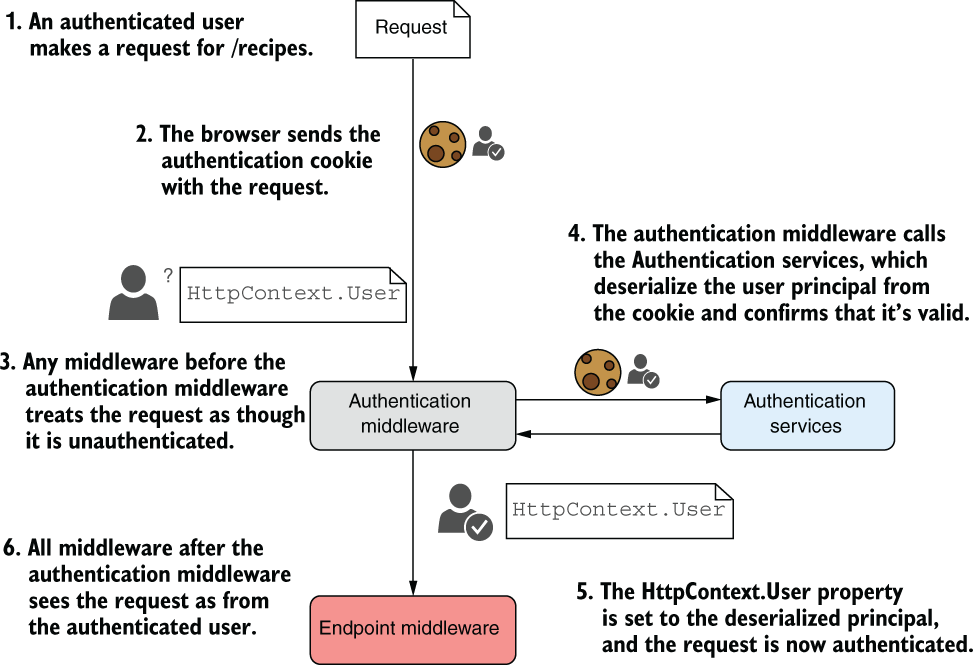
AuthenticationMiddleware authenticates an incoming HTTP request and establishes its current user. When a browser sends an authentication cookie, authentication services validate and deserialize it into a ClaimsPrincipal, which is assigned to HttpContext.User. section 23.1.2
The request pipeline behaves as follows:
- Kestrel initially assigns an anonymous principal to HttpContext.User. section 23.1.2
- AuthenticationMiddleware calls the authentication services to read, decrypt, and deserialize the authentication cookie. section 23.1.2
- The middleware replaces the anonymous principal with the authenticated ClaimsPrincipal, allowing later middleware and application code to use the current user. section 23.1.2
- Place authentication before middleware that needs an authenticated user, especially authorization middleware; UseAuthentication() makes the position explicit. section 23.7
A subsequent request after sign-in
A user signs in once, and the principal is serialized into an authentication cookie. On a later request, the browser sends that cookie automatically. AuthenticationMiddleware restores the principal and makes the user available through HttpContext.User. Later code can display the user’s name or restrict access based on claims. section 23.1.2
Figure 23.3 A subsequent request after signing in to an application. The cookie sent with the request contains the user principal, which is validated and used to authenticate the request.
Follow the request flow from the authentication cookie to validation and the authenticated user principal. section 23.1.2
