liveBook · Manning

Authoritative specification

As explained in Spec-Driven Development

An authoritative specification is a specification with high control authority and high fidelity that governs system changes while accurately representing the application.

An authoritative specification both drives application changes and faithfully represents the application. Every behavior change flows through it, and it constrains implementation with enough detail to be trusted. section 3.5.3

Control authority and fidelity distinguish four specification states:

  • Authoritative: high authority and high fidelity; drives change and accurately represents the application. section 3.5.3
  • Underspecified: high authority but low fidelity; drives change without capturing enough intent to constrain implementation. section 3.5.3
  • Reconciled: high fidelity but low authority; describes the application, while code remains the source of change. section 3.5.3
  • Decorative: low authority and low fidelity; neither drives change nor reliably represents the code. section 3.5.3
Figure 3.5 How alive a specification is depends on the control authority and fidelity.
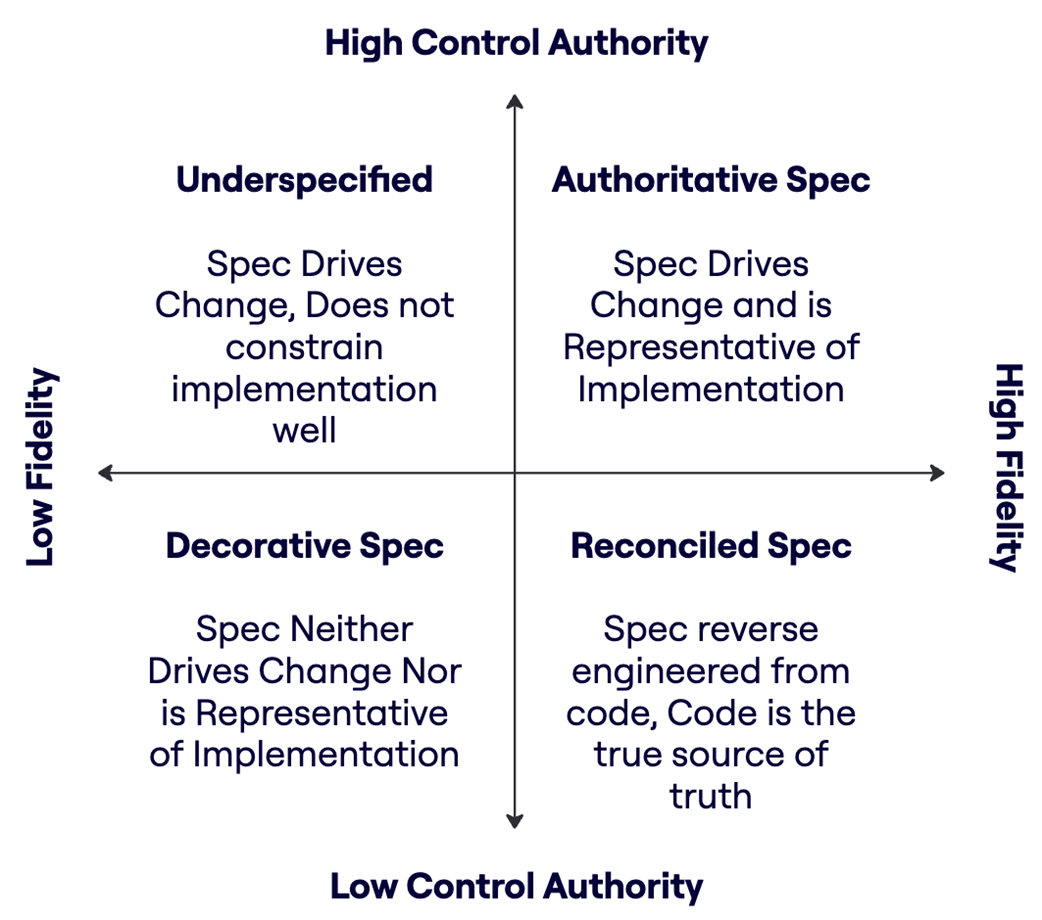
Compare specification states by plotting control authority against fidelity. section 3.5.3
How Spec-Driven Development covers it

How deep it goes
Classifies specifications across control authority and fidelity, distinguishing four states without prescribing transition steps.
Examples
Uses a two-by-two matrix to contrast authoritative, underspecified, reconciled, and decorative specifications.
What you can do after
Evaluate whether a specification drives change and faithfully constrains the application.
How it connects
Connects specification-driven development with control authority, fidelity, and implementation-led change.

Related concepts

This explainer was generated by Manning's knowledge graph from the text of Spec-Driven Development. The section links point to the parts of the book it draws on.