Authorization pressure is the growing difficulty of making access decisions consistently, explaining their outcomes, and maintaining control as systems expand. It appears when the decision surface—every situation requiring an access evaluation—grows faster than the infrastructure governing those decisions. section 19.1 section 19.10
The pressure builds when authorization logic is duplicated across applications, services, code, and configuration. Local fixes may improve individual workflows while producing inconsistent user experiences, limited decision visibility, brittle integrations, implicit trust relationships, and uncertainty about future growth. section 19.1 section 19.10
Authorization pressure becomes visible through recurring organizational and technical symptoms:
- Engineers encounter duplicated access checks and brittle integrations. section 19.1
- Security teams struggle with delegation limits, hidden trust relationships, and weak explanations of decisions. section 19.1
- Product and sales teams face slower features, stalled partnerships, custom engineering, and inconsistent customer experiences. section 19.1
- Executives see access decisions being made everywhere but governed nowhere. section 19.1
Relieving the pressure requires treating authorization as shared infrastructure rather than isolated feature logic. Externalized policies, explicit decision points, runtime evaluation, standardized policy language, reliable identity and attribute signals, governed delegation, and visible decisions support consistent behavior as contexts change. section 19.10 section 19.4
ACME Customer Collaboration
A document-sharing platform began with simple access controls, then added relationship-based collaboration, attribute-driven assurance, delegation, and real-time context. As these capabilities spread across services and teams, shared policy infrastructure made decisions more consistent and explainable, supporting complex collaboration and automation without losing control. section 19.0 section 19.4
Figure 19.1 Decision surface and decision infrastructure. As systems grow, the decision surface, the set of situations where access must be evaluated, expands faster than the infrastructure that governs those decisions. This gap creates authorization pressure: the growing difficulty of making decisions consistently, explaining outcomes, and maintaining control. Incremental architectural investments can close this gap, enabling organizations to manage trust reliably as complexity grows.
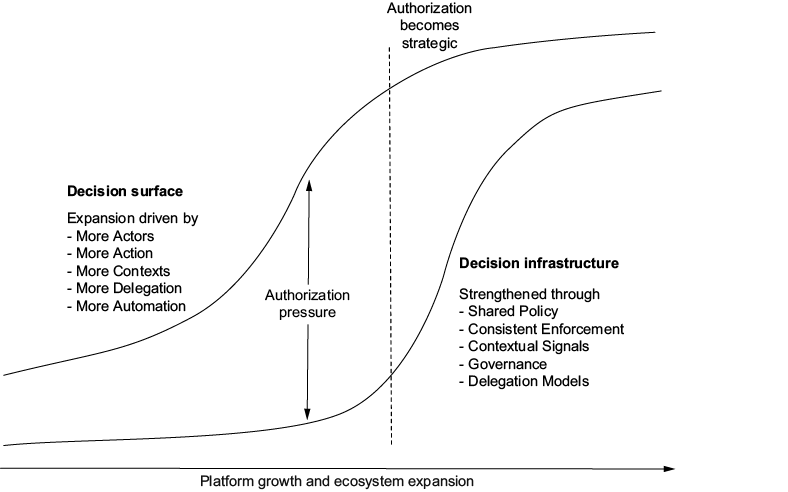
The figure contrasts an expanding decision surface with the infrastructure used to govern it, making the source of authorization pressure visible. section 19.1
