The Automated Clearing House (ACH) is a U.S. payment network for moving money between banks and credit unions. It lets participating institutions transfer funds without creating a separate relationship with every other institution—a useful capability when the country has more than 10,000 banks and credit unions. ACH is a major part of modern payment processing, even when people encounter it simply as payroll direct deposit or a scheduled loan payment. section 2.2 section 1.2.1
ACH is a practical starting point for financial-software development because it makes transaction flow visible: payment data enters a file, moves through financial institutions, and can be loaded, stored, processed, and presented in a dashboard. A full-stack implementation connects the user interface, APIs, backend processing, and database design around that workflow. section 1.1 section 1.2
A typical ACH payment flow works as follows:
- A sender, such as an employer or payroll processor, creates a file containing payment details, including an amount, account number, and routing transit number. section 2.2
- The sender's bank accepts that file, combines it with other received files, and sends a consolidated file to an ACH operator. section 2.2
- An ACH operator—the Federal Reserve or The Clearing House in this flow—sorts transactions by routing transit number and produces files for receiving banks. section 2.2
- Receiving banks obtain the resulting files and post the transactions to recipient accounts. section 2.2
Direct deposit through ACH
An employer using bank X needs to pay an employee whose account is at bank Y. Before payday, the employer or payroll processor creates a payment file with the employee's take-home pay and bank-routing details. Bank X submits the payment through an ACH operator, which routes the transaction to bank Y for posting. This pattern also supports recurring bill payments, gym memberships, and Social Security payments. section 2.2
ACH files follow a format defined by Nacha, the organization that sets ACH network standards. Parsing a sample file is therefore an important implementation step: software must interpret record layouts before it can load transaction data into a dashboard or support downstream reporting and processing. section 2.0 section 2.2
An ACH dashboard can modernize legacy operations by allowing file upload, improving reporting, and creating a foundation for transaction analytics, fraud monitoring, or transaction origination. These changes must also account for existing customer workflows and the operational role of payment-processing software. section 1.4 section 1.2
ACH remains a dominant U.S. standard while real-time payments are growing. Same-day ACH can reduce processing time from days to hours, but the broader lesson is to understand payment-processing flows independently of any one payment technology. section 1.2.1
Figure 2.1 ACH processing flow
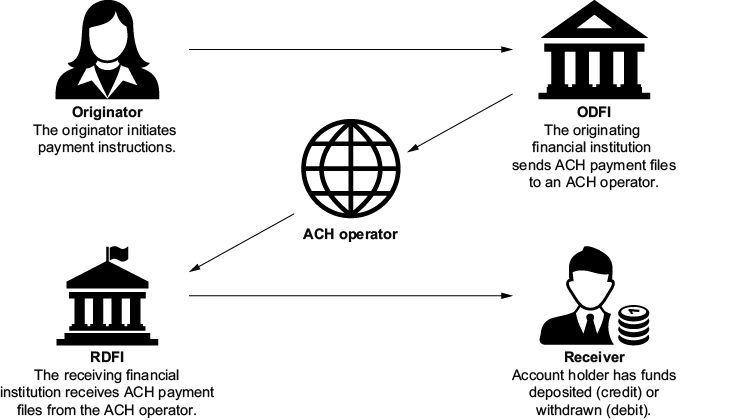
Trace the route from a payment-originating bank through an ACH operator to the receiving bank before implementing file parsing or dashboard processing. section 2.2
