liveBook · Manning

Automated review

As explained in "Looks Good to Me"

An AI-assisted assessment of a submitted pull request that produces an overall analysis and review feedback.

Automated review uses an AI tool to assess a submitted pull request, producing an overall analysis, review feedback, and checks for issues such as missing tests or obvious security vulnerabilities. It supports human reviewers rather than replacing them: false positives, false negatives, and hallucinations still require validation. section 13.3

A practical review workflow is to:

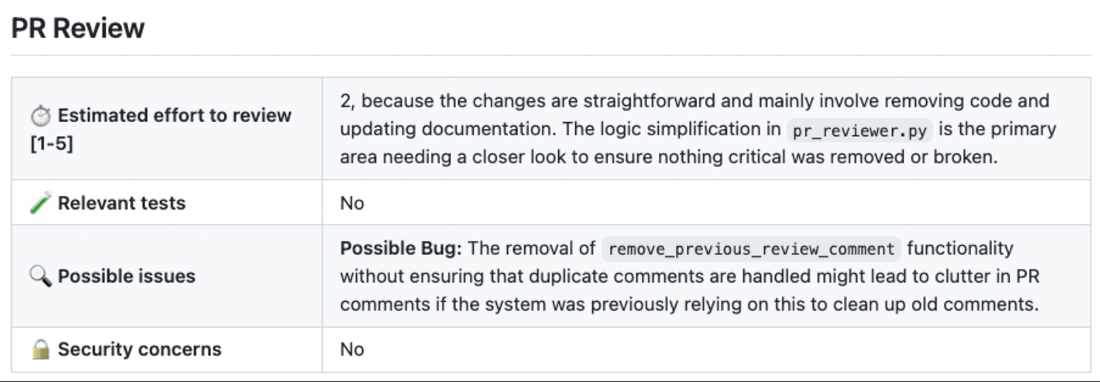
  • Run Qodo’s /review command to generate a PR Analysis covering the change type, summary, tests, review effort, and security concerns. section 13.3
  • Use general and file-specific feedback to begin addressing comments before human review. section 13.3
  • Validate the findings manually, then focus human attention on the code instead of repetitive checks. section 13.3
Figure 13.5 Qodo’s PR Analysis output after running the /review command
figure

Inspect a representative PR Analysis output from Qodo’s /review command. section 13.3

How "Looks Good to Me" covers it

How deep it goes
Combines overall PR analysis with general and file-specific feedback, while stopping short of replacing human validation.
Examples
Uses Qodo’s /review command and PR Analysis to summarize changes, tests, review effort, security concerns, and file-level feedback.
What it assumes
Assumes a submitted pull request and requires reviewers to validate AI-generated findings rather than accept them automatically.
What you can do after
Apply it via Qodo’s /review command to obtain a curated synopsis and address likely feedback before human review.
How it connects
Connects pull requests, code review, large language models, testing, security vulnerabilities, and human validation.

Related concepts

This explainer was generated by Manning's knowledge graph from the text of "Looks Good to Me". The section links point to the parts of the book it draws on.