liveBook · Manning

Autoregressive model

As explained in The Art of AI Product Development

An autoregressive language model generates each token by predicting it from the preceding context.

An autoregressive model generates text one token at a time, predicting the next token from the preceding context. Repeating this prediction produces a complete sentence or passage that aims to be coherent and correct. section 5.1.2

This objective is powerful but directional: the model uses information from only one side of the predicted token. That restriction matters when a word depends on both preceding and following words. section 5.1.2

Completion versus conversation

A model trained on the raw language-modeling objective may continue text without recognizing the conversational intent behind a prompt. ChatGPT can respond more naturally because it was fine-tuned for human-like conversation, illustrating that next-token prediction and useful interaction are related but distinct goals. section 5.1.2

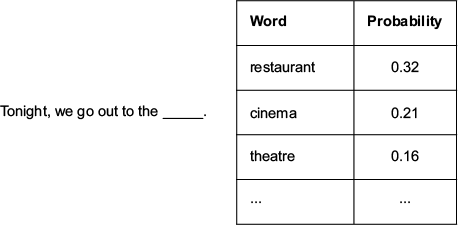
Figure 5.3 The objective of language modeling is to predict words based on their context.
A close-up of a screen

AI-generated content may be incorrect.

Use the context-prediction illustration to see how preceding words guide the next-token objective. section 5.1.2


How The Art of AI Product Development covers it

How deep it goes
Defines next-token prediction and its directional limitation, but stops short of implementation details.
Examples
Uses sentence completion, Mistral, ChatGPT, and context illustrations to contrast raw prediction with conversational behavior.
What you can do after
Evaluate how next-token objectives support generation while limiting context and conversational usefulness.
How it connects
Connects autoregression with language modeling, sequence-to-sequence transduction, autoencoding, transformers, and fine-tuning.

Also explained in

Compare how 5 books explain autoregressive model →

Related concepts

This explainer was generated by Manning's knowledge graph from the text of The Art of AI Product Development. The section links point to the parts of the book it draws on.


