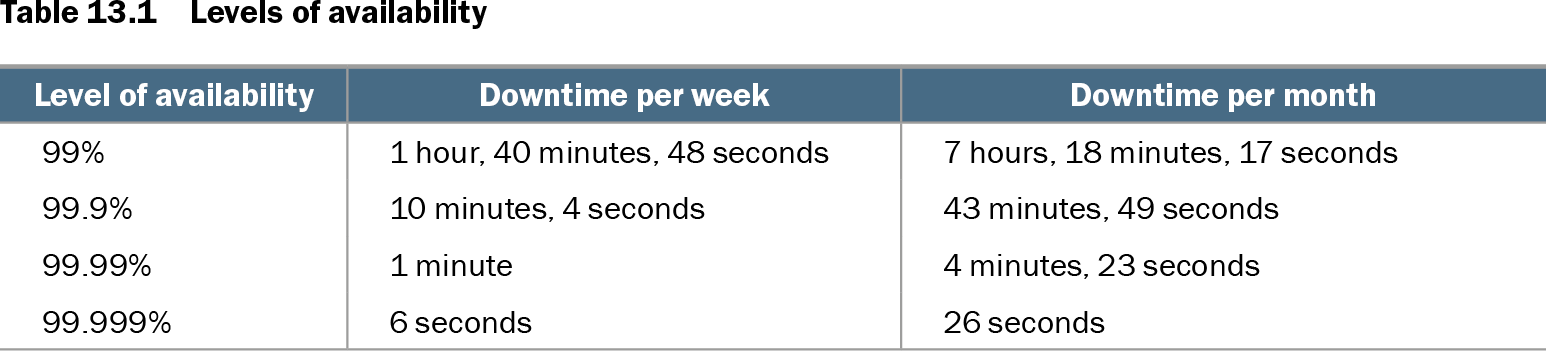
A common mistake is accepting an application owner's availability target without translating it into downtime and cost. “Four nines” means 99.99% availability; “five nines” means 99.999%. Five nines permits only 6 seconds of weekly downtime, so even a brief network problem can consume the allowance. section 13.2
Table 13.1 Levels of availability (view table figure)
| Level of availability |
Downtime per week |
Downtime per month |
|---|---|---|
| 99% |
1 hour, 40 minutes, 48 seconds |
7 hours, 18 minutes, 17 seconds |
| 99.9% |
10 minutes, 4 seconds |
43 minutes, 49 seconds |
| 99.99% |
1 minute |
4 minutes, 23 seconds |
| 99.999% |
6 seconds |
26 seconds |
Use the availability table to convert percentage targets into allowable downtime: 99.9% permits 43 minutes, 49 seconds monthly; 99.99% permits 4 minutes, 23 seconds; 99.999% permits 26 seconds. section 13.2
The five-nines request
A five-nines target may sound reasonable until its infrastructure consequences are visible. Achieving it can require costly local and geographically dispersed redundancy with redundant private links. A stand-alone server on a major public cloud platform was described as receiving only a 95% monthly uptime SLA at the time of writing. section 13.2
Apply the metric as a cost-and-requirements check:
- Calculate tangible and intangible downtime costs before selecting an HA/DR solution. section 13.2
- Reject designs whose redundant solution costs more than the application's downtime, and test DR rather than assuming synchronization guarantees failover. section 13.6