Average embeddings replace a variable-length sequence with one fixed-size representation. For input X of shape (B, T, D), compute the mean across time: X̄ = mean(X, dim=1), producing (B, D). This removes the time dimension so ordinary fully connected layers can process the result. section 12.2
A direct PyTorch implementation follows these steps:
- Map token indices from (B, T) to embeddings with shape (B, T, D). section 12.2
- Apply shared linear layers independently at every time step. section 12.2
- Use nn.AdaptiveAvgPool2d((1, D)) to transform (B, T, D) into (B, 1, D), then flatten to (B, D). section 12.2
- Finish with hidden layers and a classifier. section 12.2
Tradeoff
Averaging is simple and fast, and it works when T changes between batches. It discards order and temporal structure, so faster training can produce worse predictions. section 12.2
Figure 12.1 Example of averaging embeddings over time. The T inputs over time are processed by the same neural network via weight sharing. Because there are no connections across time, the model is unaware that there is an order to them. The time dimension is resolved by simply averaging all of therepresentations so a regular fully connected network can run afterward to produce the output.
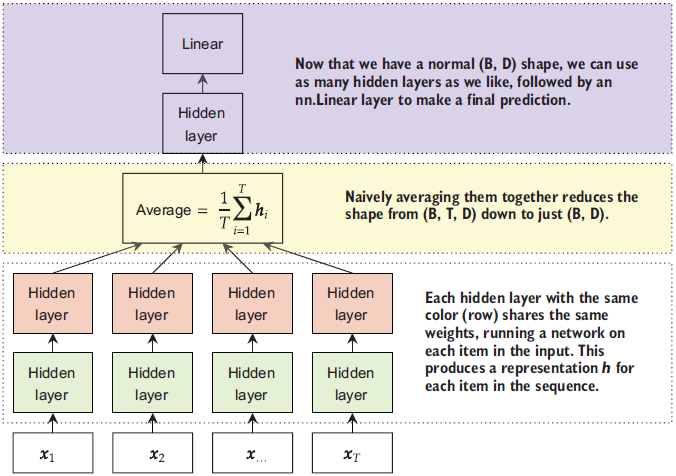
Visualizes shared processing across time and the final averaging step before a fully connected network. section 12.2
