liveBook · Manning

Average transaction value

As explained in Data Without Labels

Average transaction value is total revenue divided by the number of invoices over a specified set of transactions.

Average transaction value (ATV) is a derived metric calculated as total revenue or sales divided by the number of invoices or transactions. It adds a customer-level spending measure to raw variables such as Revenue and Invoices. section 2.6.2 section 3.4

Customer-level calculation

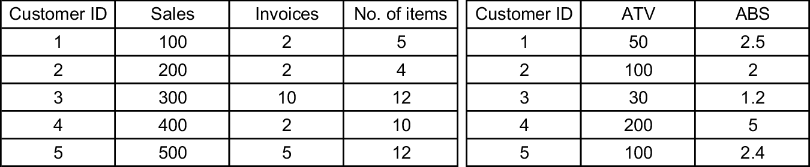
A customer with two invoices, five items, and total sales of 100 has an ATV of 50. The same table can derive average basket size as 2.5 items per invoice. section 3.4

Use ATV when combining transaction variables for analysis or dimensionality reduction. It can reduce several variables to a more interpretable representation, but it should not automatically replace sales; inspect data quality and variable relationships before dropping information. section 3.4 section 3.8

Figure 3.3 In the first table, we have the sales, invoices, and number of items as the variables. In the second table, they have been combined to create new variables.
figure

Compare the original sales, invoices, and item-count variables with the reduced table containing ATV and average basket size. section 3.4


How Data Without Labels covers it

How deep it goes
Defines the ratio and works one numerical example, then stops short of prescribing replacement or advanced statistical treatment.
Examples
Demonstrates two invoices and 100 in sales producing ATV 50, alongside average basket size 2.5.
What it assumes
Assumes basic transaction totals and invoice counts, while introducing derived attributes and variable combination from those raw measures.
What you can do after
Apply the ratio to create a derived transaction feature and assess whether combining variables supports analysis.
How it connects
Connects revenue, invoices, average basket size, data cleaning, exploratory data analysis, and dimensionality reduction.

Also explained in

Compare how 2 books explain average transaction value →

Related concepts

This explainer was generated by Manning's knowledge graph from the text of Data Without Labels. The section links point to the parts of the book it draws on.