Azure Kubernetes Service (AKS) is Azure’s managed Kubernetes offering. Azure creates and configures the control plane, allowing teams to focus on applications instead of managing cluster infrastructure. section 4.3.5
AKS uses shared responsibility. Microsoft maintains the control plane and provides weekly worker-node patches and images, while you apply worker-node operating-system and runtime patches and keep the Kubernetes version current. section 4.3.5
Secure AKS across the container lifecycle:
- Build images from trusted base images and scan them for known vulnerabilities before pushing them to a container registry. section 4.4.2
- Continue scanning registry images for newly surfaced vulnerabilities, including zero-day vulnerabilities. section 4.4.2
- Secure the registry by disabling public access, encrypting images at rest, and enforcing role-based access control (RBAC). section 4.4.2
- Use Kubernetes admission controllers to enforce organization-wide policies, including least-privilege container access, trusted registries, and CPU and memory limits. section 4.4.2
- Limit Kubernetes API-server access, such as by placing the server in a private virtual network and enforcing RBAC. section 4.4.2
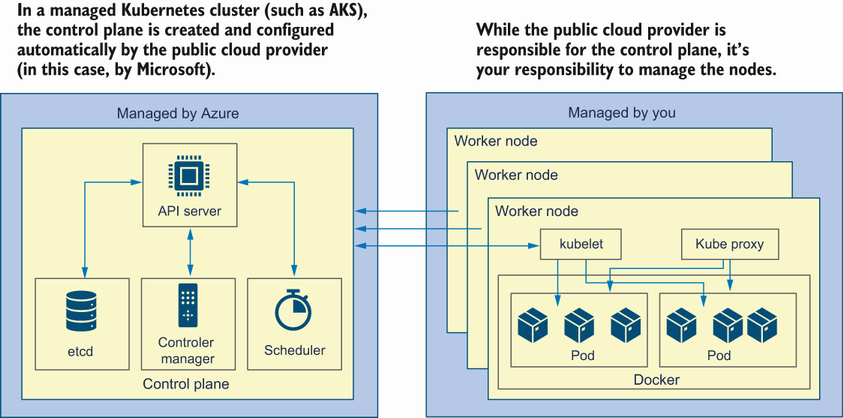
Use the figure to distinguish Azure-maintained AKS control-plane components from customer-managed worker-node responsibilities. section 4.3.5
