A fractal pattern is behavior or structure that repeats across time and organizational levels. In collaborative modeling, observers look for patterns in individuals, groups, and the wider organization. section 5.1.1
Repeated blame can expose a fractal pattern: developers criticize other departments, while those departments make similar accusations about the developers. The repetition signals an organizational or team culture rather than an isolated incident. section 5.1.1
Open doors, shared responsibility
Doors repeatedly remain open despite notes asking people to close them. Because everyone is responsible but nobody actively manages the task, the physical problem mirrors an organizational pattern of unmanaged shared responsibility. section 5.2.2
Use observation to test whether a pattern is genuinely fractal:
- Record observable behavior without inferring motives, such as counting interruptions rather than explaining why someone interrupts. section 5.1.1
- Compare the behavior across individuals, teams, departments, and management levels. section 5.1.1
- Use a metaphorical flashlight to notice emotional shadows, including fear, insecurity, grief, stress, and cognitive bias. section 5.2.2
Figure 5.2 A fractal triangle pattern. This triangle is repetitive at every scale. The big triangle comprises three smaller triangles. Those smaller triangles comprise three even smaller triangles. You’ll find fractal patterns also in companies. Patterns exhibited by higher management will be observable on lower levels of the company.
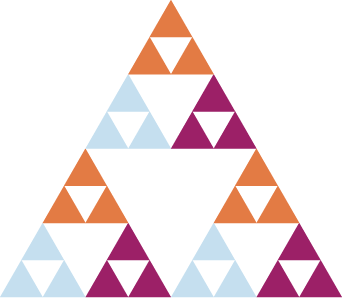
A repeating triangle illustrates how the same form can appear at progressively smaller scales, providing a visual analogy for organizational patterns. section 5.1.1
