Group unconsciousness consists of unrecognized influences that shape behavior during collaborative modeling. It appears in who speaks, who stays quiet, which minority perspectives surface, where people stand, and which subgroups form. section 4.3.1
Model these influences as shadows rather than an iceberg: cognitive bias, ranking, and polarities may be unconscious, yet facilitators can observe their effects. Shadows vary from subtle and light to large, dark, and personal. section 4.3.1
Facilitation makes the hidden dynamics workable:
- Notice behavioral signals such as persistent talking, non-listening, suppressed participation, and emerging subgroups. section 4.3.1
- Use the flashlight metaphor: expose a shadow, make it visible to the group, and reduce its intensity before it becomes an unmanageable demon. section 4.3.1
A collaborative modeling session
When some participants only talk and never listen, while others want to keep modeling instead of coding, those patterns may reveal suppressed group dynamics. Their effects can expose who participates, whose perspective is missing, and how the group organizes itself. section 4.3.1
Figure 4.7 Example of shadows that live in the unconsciousness of the group during collaborative modeling
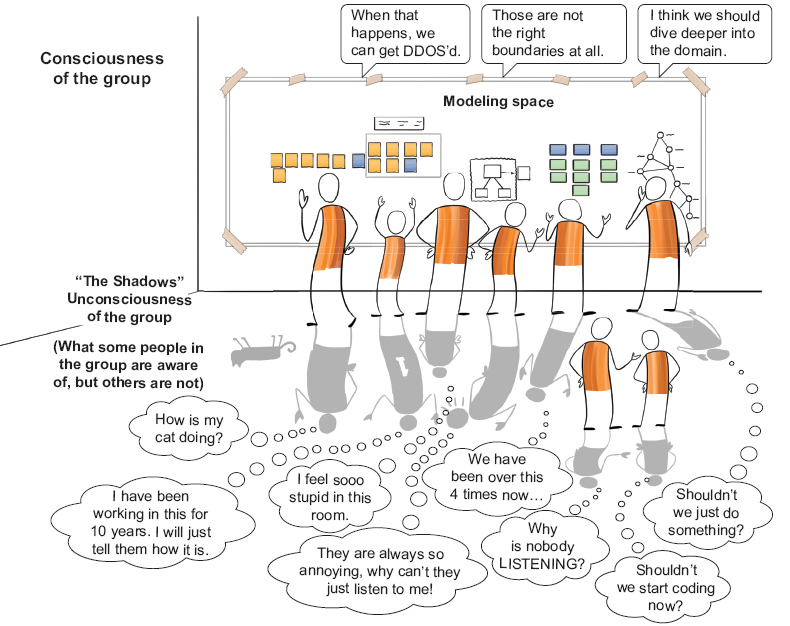
Use the shadows diagram to inspect how unconscious group dynamics become visible during collaborative modeling. section 4.3.1
