A hotspot is a visible marker for something that needs attention: difficulty, interpersonal conflict, missing knowledge, or a branch in an explored timeline. It prevents an unresolved point from silently steering a group’s model or conversation. section 2.3.2 section 8.3.2
In EventStorming, use a neon-pink sticky note when disagreement cannot be resolved quickly or when discussion is becoming stuck. Marking the issue lets the group continue assembling one meaningful timeline and return to the question without losing it. section 2.3.2
Figure 2.16 Example of how to proceed with enforcing the timeline in EventStorming where the groups merge all of their own models into one timeline of the scenario. We added a pivotal domain event where we can now decide what is inside our storyline and what happened before.
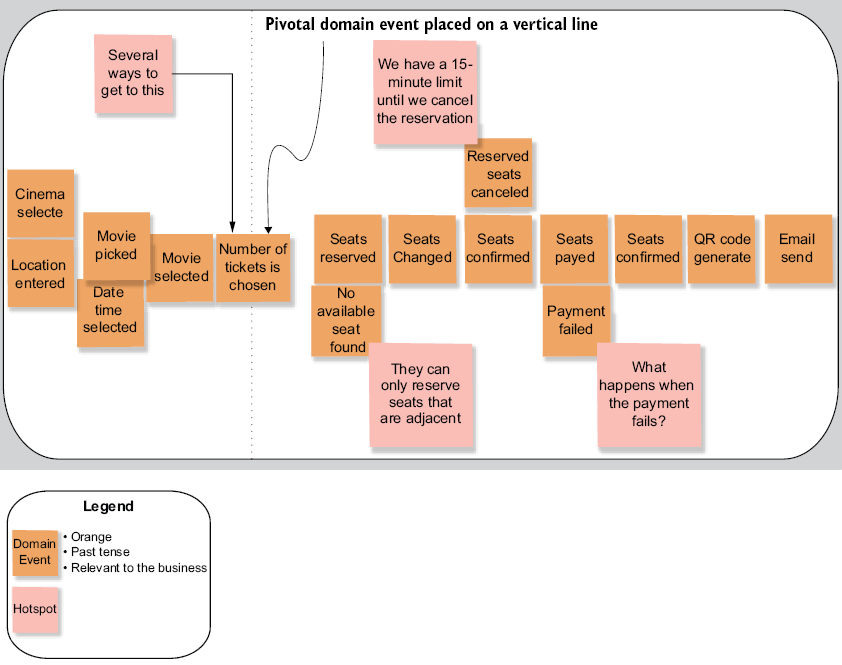
The merged timeline illustrates a pivotal event that separates what belongs in the current storyline from what happened earlier; hotspots can preserve unresolved branches while that storyline is completed. section 2.3.2
Use hotspots to protect both focus and discovery:
- Finish the happy path before investigating side effects or alternate branches. section 2.3.2
- Keep dialogue open long enough to reveal uncertainty and disagreement, rather than narrowing the discussion too early. section 2.3.2
- Set a narrative boundary at a pivotal event when earlier or adjacent activity does not serve the session’s goal. section 2.3.2
- Treat conflict as a signal for attention, not merely an obstacle to remove. section 8.3.2
A payment failure on a ticket-reservation timeline
While mapping ticket reservation, the group reaches “Payment failed” and disagrees about what happens next. Mark the point as a hotspot, complete the reservation happy path, and return later to explore the failure branch. If movie-selection routes are distracting from reservation, place a boundary at “movie is selected” and “number of tickets is chosen” so the group can keep its shared narrative focused. section 2.3.2 section 2.3.2
A hotspot can also be emotional rather than procedural. Notice patterns of resistance, tension, or edge behavior while maintaining neutrality. Bring the issue to the group gently: a climate report starts with neutral, factual observations using participants’ own words. The aim is to help the group confront difficult tensions without pressuring people beyond their comfort zone. section 8.3.2 section 8.3.2
Do not confuse marking a hotspot with avoiding it. Deferral serves the group when it preserves momentum toward an agreed goal; later engagement can produce understanding and resolution. Forcing engagement, especially where rank differs, can create stress, damage relationships, or fracture the group. section 8.3.2 section 8.3.2
