A neutral consequence is an alternative’s effect that is neither beneficial nor harmful in the relevant context. Its classification depends on the team’s circumstances. section 11.1.1
Learning Python for a prototype
A team choosing between C# and Python for a microservice prototype may classify learning Python as neutral. The team must spend time learning it, but strong organizational support for education makes the effort neither a pro nor a con. Without that support, the same consequence could become a downside. section 11.1.1
Use neutral consequences to make collaborative decision records more realistic:
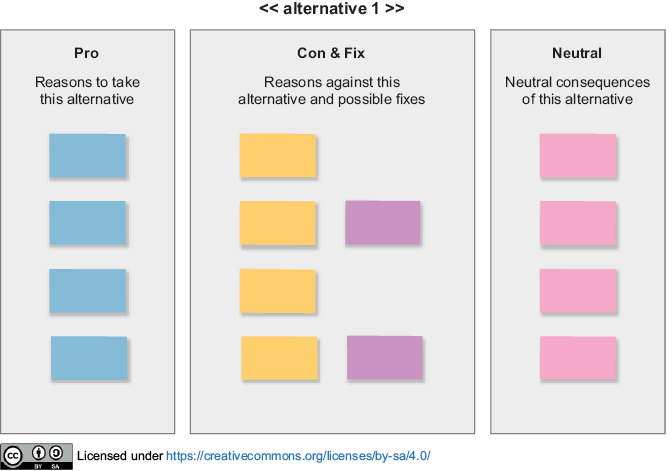
- Extend a Pros-Cons-and-Fixes list with a neutral column. section 11.1.1
- Have people brainstorm individually, then group and reconcile their classifications as a team. section 11.1.1
- Use separate passes for identifying cons and proposing fixes so every concern receives consideration. section 11.1.1
Figure 11.3 Extend the Pros-Cons-and-Fixes list to capture the neutral consequences of an alternative. Whether something is pro, con, or neutral depends on the context because what is neutral for one team can be a con for another.
Use the extended Pros-Cons-and-Fixes model to record neutral consequences and discuss how context changes their classification. section 11.1.1
