Preparation is the first stage of collaborative modeling: organize both the session content and its space before people arrive. A clear plan gives the group a shared purpose, reduces confusion, and still leaves room to follow discoveries that emerge during modeling. section 4.1.2 section 4.2 section 5.3.1
Prepare a session by deciding:
- The goal and intended outcome. section 4.1.2 section 5.3.1
- Who to invite, where to meet, and how to arrange the space. section 4.1.2 section 5.3.1
- The agenda, tools, materials, and check-in, check-out, and sensemaking exercises. section 4.1.2 section 5.3.1
- Likely questions, conflicts, tensions, power dynamics, and hidden agendas that could shape participation. section 5.4.4
- Backup exercises and relevant collaborative styles, while treating both as adjustable rather than fixed. section 5.4.4 section 5.4.5
Preparation is not a script. Modeling is exploratory, so a facilitator balances a stated goal and enabling constraints with attention to where the group needs to go. Agreements made in advance—such as when a large group will split—can make later interventions easier to understand and accept. section 4.1.2 section 5.4.5
Preparing a sensemaking prompt
To open a conversation about feature delivery and expectations, ask participants to place a dot where they spend most of their time. Keep prior exercises and their outcomes available for follow-up reflection, then adapt the next prompt to what the group reveals. section 5.4.4
Figure 5.9 One of the sensemaking exercises we did during an EventStorming session. We wanted to trigger a conversation on feature delivery and expectation so we asked the participants to place a dot where in general they spend most of their time on.
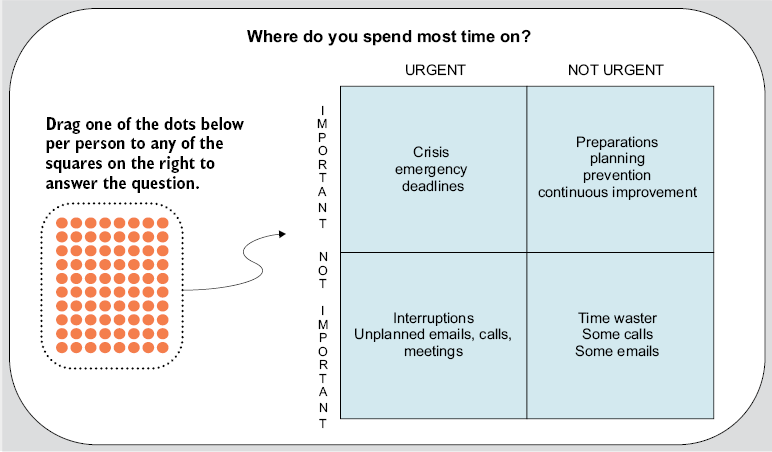
Use the dot-placement exercise as a lightweight visual prompt for surfacing how participants perceive their work and expectations. section 5.4.4
