liveBook · Manning

Bootstrapped lower confidence bound of recall at a given specificity

As explained in Machine Learning System Design

A one-sided bootstrap-based lower confidence estimate of recall conditional on achieving a specified specificity.

When a model must achieve a specified specificity, this metric gives a one-sided, bootstrap-based lower confidence estimate of the recall it can be expected to deliver. It supports robust evaluation when data distributions and model versions change over time. section 7.4

Reading the recall distribution

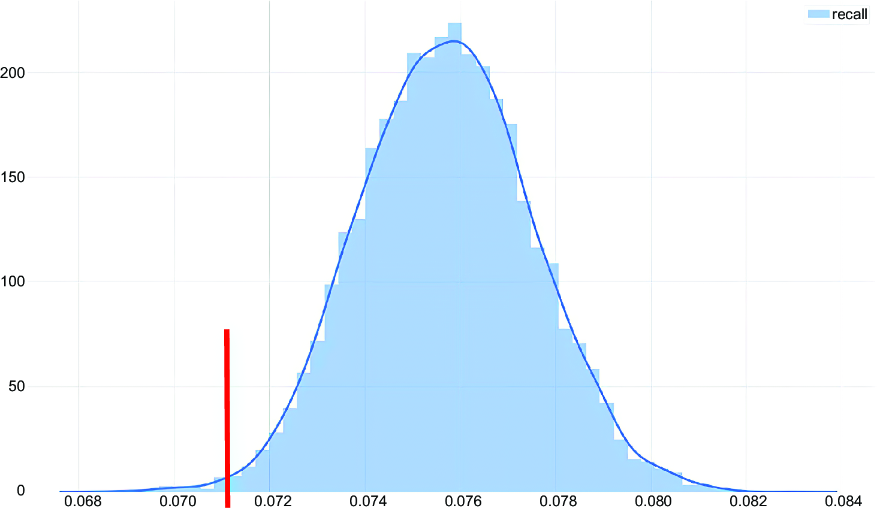
A bootstrapped recall distribution can be paired with a red 99% lower confidence bound. Comparing this bound across sample sizes, with and without added noise, shows how the estimate behaves under different evaluation conditions. section 7.4

Distribution recall with every point being a bootstrapped original dataset; the red line is a 99% lower confidence bound.
sidebar figure

Use the figure to inspect the bootstrapped recall distribution and its 99% lower confidence bound. section 7.4

How Machine Learning System Design covers it

How deep it goes
Defines a one-sided bootstrap lower bound and illustrates its distribution, without detailing a calculation procedure.
Examples
Uses bootstrapped recall distributions, a 99% lower-bound line, varying sample sizes, and added-noise comparisons.
What you can do after
Evaluate recall conservatively at a chosen specificity using a robust confidence estimate.
How it connects
Links recall, specificity, bootstrap resampling, confidence bounds, and validation.

This explainer was generated by Manning's knowledge graph from the text of Machine Learning System Design. The section links point to the parts of the book it draws on.