liveBook · Manning

Backlog

As explained in Delivering Machine Learning Projects: From design to deployment

A backlog is an ordered or enumerated list of work items and tasks for a project or development cycle.

A backlog is an enumerated list of work items that organizes delivery into manageable project phases. In machine learning projects, backlogs structure work as sprints, tickets, and checkpoints while leaving room for iteration and rework. section 1.4

Use a backlog to make delivery work visible and governable:

  • Create tickets for requirements, infrastructure, data investigation, ethics, privacy, security, documentation, and project planning. section 2.1 section 4.1
  • Assign responsibility and track progress in a project management system so tasks are less likely to be forgotten. section 2.1
  • Decompose chapter or phase backlogs into project tasks, then add or remove work as requirements and discoveries change. section 3.2.1 section 4.1
  • Finish sprint work with checklists and documentation that support team coordination, reuse, maintenance, and production governance. section 1.4

A backlog across the delivery lifecycle

A pre-project backlog can begin with PS1, setting up a task board, and continue through requirements, system constraints, data investigation, estimates, and proposals. Sprint 0 then adds team design, ways of working, infrastructure, data verification, ethics, privacy, security, and a roadmap. After production, Sprint Ω tracks model performance, drift, obsolescence, technical debt, lessons learned, and new practices. section 2.1 section 4.1 section 10.1

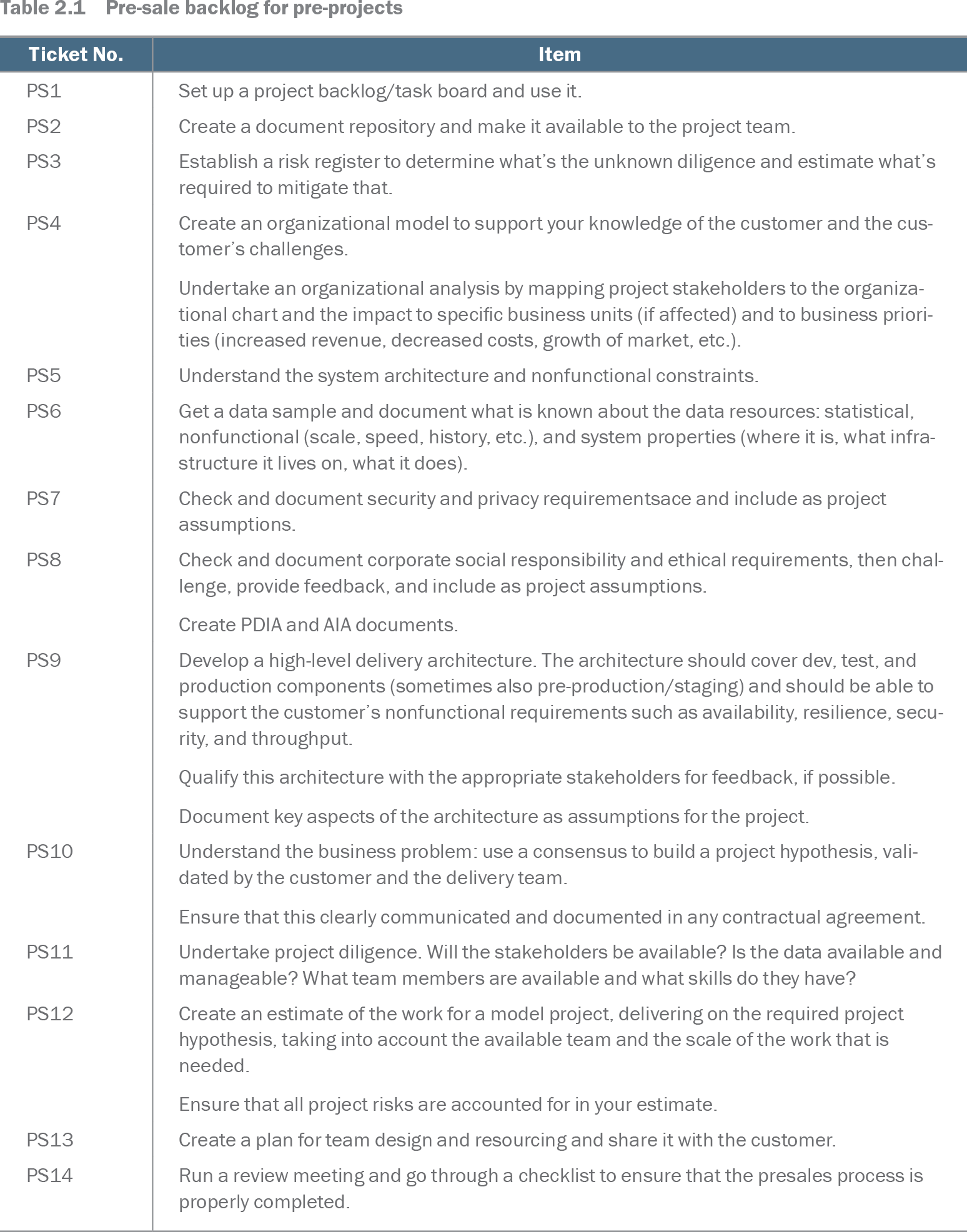
Table 2.1 Pre-sale backlog for pre-projects (view table figure)

Ticket No.

Item

PS1

Set up a project backlog/task board and use it.

PS2

Create a document repository and make it available to the project team.

PS3

Establish a risk register to determine what’s the unknown diligence and estimate what’s required to mitigate that.

PS4

Create an organizational model to support your knowledge of the customer and the customer’s challenges.

Undertake an organizational analysis by mapping project stakeholders to the organizational chart and the impact to specific business units (if affected) and to business priorities (increased revenue, decreased costs, growth of market, etc.).

PS5

Understand the system architecture and nonfunctional constraints.

PS6

Get a data sample and document what is known about the data resources: statistical, nonfunctional (scale, speed, history, etc.), and system properties (where it is, what infrastructure it lives on, what it does).

PS7

Check and document security and privacy requirementsace and include as project assumptions.

PS8

Check and document corporate social responsibility and ethical requirements, then challenge, provide feedback, and include as project assumptions.

Create PDIA and AIA documents.

PS9

Develop a high-level delivery architecture. The architecture should cover dev, test, and production components (sometimes also pre-production/staging) and should be able to support the customer’s nonfunctional requirements such as availability, resilience, security, and throughput.

Qualify this architecture with the appropriate stakeholders for feedback, if possible.

Document key aspects of the architecture as assumptions for the project.

PS10

Understand the business problem: use a consensus to build a project hypothesis, validated by the customer and the delivery team.

Ensure that this clearly communicated and documented in any contractual agreement.

PS11

Undertake project diligence. Will the stakeholders be available? Is the data available and manageable? What team members are available and what skills do they have?

PS12

Create an estimate of the work for a model project, delivering on the required project hypothesis, taking into account the available team and the scale of the work that is needed.

Ensure that all project risks are accounted for in your estimate.

PS13

Create a plan for team design and resourcing and share it with the customer.

PS14

Run a review meeting and go through a checklist to ensure that the presales process is properly completed.

Browse the pre-sale backlog table for a concrete ticket sequence covering project setup, risks, stakeholders, architecture, and data. section 2.1

How Delivering Machine Learning Projects: From design to deployment covers it

How deep it goes
Defines backlog use through ticket decomposition, estimation, checklists, and adaptation, without specifying a universal prioritization method.
Examples
Uses pre-sale, Sprint 0, and Sprint Ω backlogs with task boards, ticket identifiers, checklists, and production-maintenance activities.
What it assumes
Assumes an agile project structure and basic ticketing practice while teaching how to establish the backlog from the first pre-project task.
What you can do after
Operate/configure a project backlog using a task board, decompose work, assign responsibility, estimate effort, and review completion.
How it connects
Connects backlogs to agile development, sprints, tickets, project management, documentation, governance, and technical debt.

Related concepts

This explainer was generated by Manning's knowledge graph from the text of Delivering Machine Learning Projects: From design to deployment. The section links point to the parts of the book it draws on.