A backward pass finds the latest start and finish times each activity can have without delaying project completion. It traverses a dependency network from the project finish toward earlier activities, complementing the forward pass. section 13.3 section 13.3.2
Calculate latest times by working backward through the schedule:
- Set the final activity’s latest finish to the project completion time. Subtract its duration to find its latest start. section 13.3.2
- For each preceding activity, set its latest finish to the earliest latest start among its immediate successors. Subtract its duration to find its latest start. section 13.3.2
- Compare latest and earliest times to calculate slack. Activities with zero slack are critical; delaying one affects the project completion date. section 13.3.3
Automated reporting tool schedule
With a 29-week completion time, final activity L has latest finish 29 and latest start 27 for its two-week duration. Its predecessor K has latest finish 27 and latest start 24 for its three-week duration. The Python implementation stores latest times and uses them with earliest times to calculate slack. section 13.3.2 section 13.3.4
Figure 13.3 A second visual representation of the automated reporting tool project plan. The new three-digit sequence for each activity represents, in order, the latest start time, the expected duration, and the latest finish time. A quick and easy way of distinguishing critical tasks from noncritical tasks is to compare the three-digit sequences: critical tasks have similar three-digit sequences, whereas noncritical tasks do not.
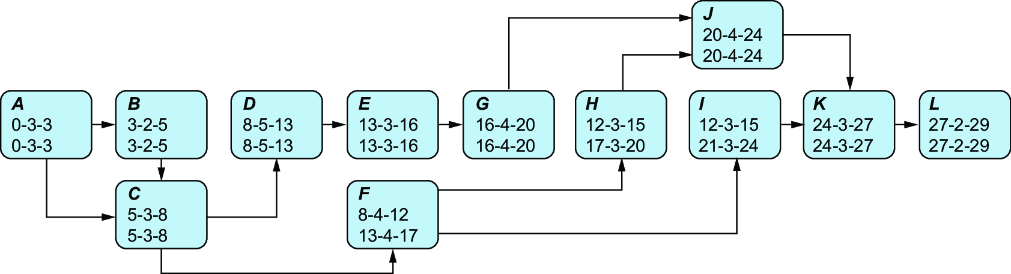
The network diagram adds latest start, duration, and latest finish values for each activity, making critical and noncritical tasks easier to compare. section 13.3.2
