liveBook · Manning

Backward recovery

As explained in Think Distributed Systems

Backward recovery is a failure-mitigation strategy that returns a system from an illegal intermediate state to a state equivalent to its initial legal state.

Backward recovery mitigates failure by moving a process from an illegal intermediate state back to a state equivalent to its initial legal state. It treats incomplete execution as undesirable and aims to make the failed process observably equivalent to no application. section 3.3.1 section 3.3.5

The usual application-level mechanism is compensation: undo completed steps instead of repairing the failure and pushing forward. This often avoids fixing the underlying cause, but compensation can fail and require human intervention. section 3.3.5 section 3.3.6

Checkout payment

A checkout may charge a customer before a later step fails. Backward recovery compensates for the charge, aiming for the legal outcome in which the checkout never occurred. A successful checkout must charge exactly once; a failed checkout must not leave a charge. If the refund fails, operators may need to issue a refund manually. section 3.3.1 section 3.3.6

Figure 3.15 Failure mitigation
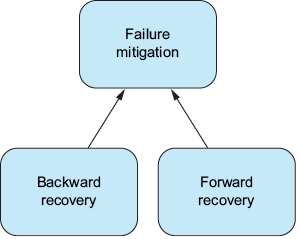
A diagram of a failure mitigation

AI-generated content may be incorrect.

Use the failure-mitigation diagram to contrast moving backward to the initial legal state with moving forward to the final legal state. section 3.3.5

How Think Distributed Systems covers it

How deep it goes
Defines illegal and legal states, contrasts forward recovery, and illustrates compensation and its human-escalation limit.
Examples
Uses e-commerce checkout, credit-card charging, shipment or ticket issuance, and refund compensation.
What it assumes
Assumes a process model with sequential steps, failures, and distinguishable legal and illegal states.
What you can do after
Apply it by designing compensating actions for completed steps and escalating compensation failures to operators.
How it connects
Connects process completeness, failure mitigation, compensation, forward recovery, application-level failures, and human escalation.

Related concepts

This explainer was generated by Manning's knowledge graph from the text of Think Distributed Systems. The section links point to the parts of the book it draws on.