Backward secrecy prevents an observer who sees current pseudorandom output from predicting values generated later. It is a required property of a cryptographically secure pseudorandom number generator. section 2.2.3
Predicting future output from an LCG
An attacker who knows the linear congruential generator, its constants, and the current output 1634248641 can seed an identical LCG clone and generate subsequent values. Because the generator exposes its internal state directly as output, observing one value reveals the state needed to continue the sequence. section 2.2.3
A defensive design separates internal state from emitted output with a transformation that is hard to reverse. This prevents an observed value from immediately revealing the state used to produce later values. section 2.2.3
Figure 2.10 Some PRNGs transform the state before outputting it as the next value.
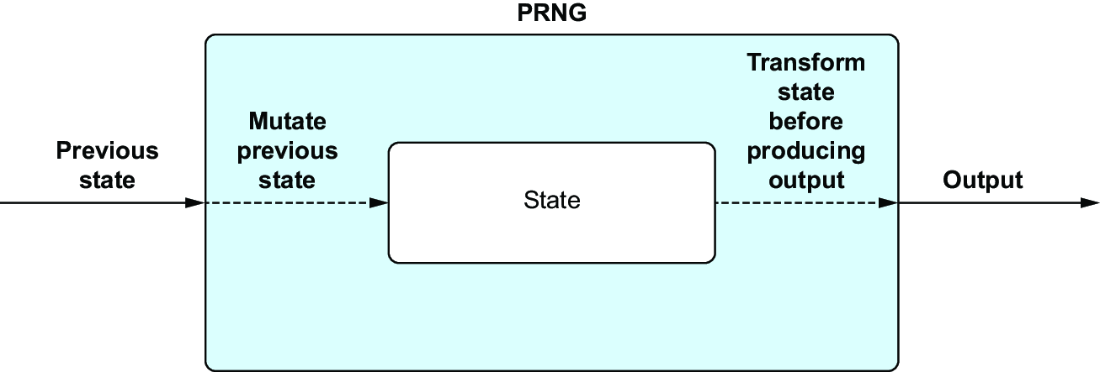
Use the state-to-output diagram to compare direct state exposure with transformed output. section 2.2.3
