The Summary pattern organizes React components by moving logic from the area above the JSX return into custom hooks. The component becomes shorter, clearer, and easier to maintain while preserving a focused rendering structure. section 2.3
Figure 2.9 The essence of the Summary pattern captured in a simple diagram. Before, the component consisted of a bunch of code before the JSX and then a bunch of JSX. After, the component is a few lines before the JSX, and all the remaining code has been put in a custom hook specific to that component.
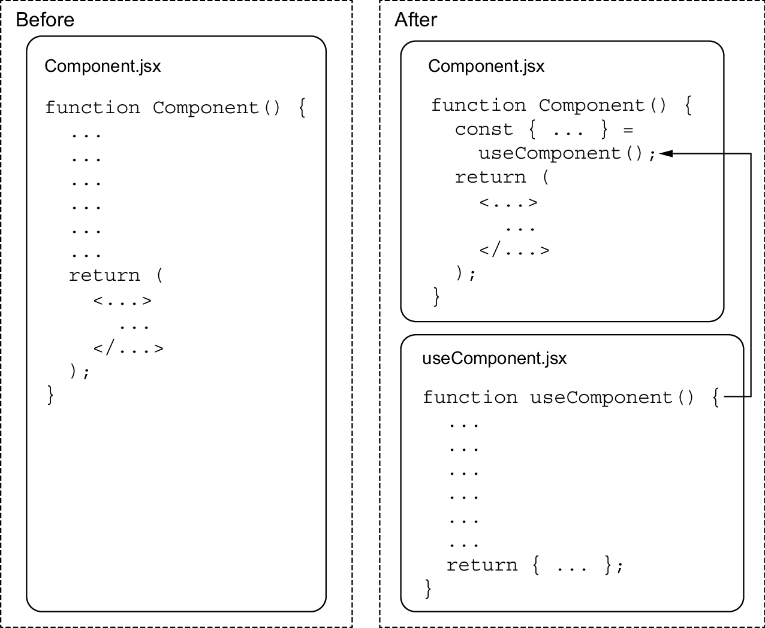
Compare the before-and-after structure: extensive pre-JSX logic becomes a small setup area, while the extracted logic resides in a component-specific custom hook. section 2.3
Apply the pattern according to the component's logic:
- Extract a component's logic into one custom hook when a single cohesive abstraction is sufficient. section 2.3
- Split more complex logic across two or three custom hooks when separate concerns benefit from organization and reuse. section 2.3
- Use the resulting structure to improve readability, collaboration, maintainability, scalability, and consistency across larger projects. section 2.3.4
Single-hook and multi-hook components
A simple component can delegate its pre-JSX logic to one custom hook. A more complex component can coordinate two or three hooks, producing a smaller component surface while retaining reusable, separately organized logic. section 2.3
