Barman is an open-source PostgreSQL backup and disaster-recovery tool. It replaces error-prone manual backups with scheduled, monitored automation and supports continuous WAL archiving for Point-in-Time Recovery (PITR). section 9.3
A typical deployment uses Barman to pull base backups with pg_basebackup and receive WAL through a replication connection. It can also configure archive_command to transfer WAL with rsync, including parallel transfer for high WAL volume. section 9.3
Use Barman with these operational safeguards:
- Schedule backups rather than relying on operators to remember them. section 9.3
- Combine physical base backups with continuous WAL archiving; logical backups cannot provide PITR with WAL files. section 9.3
- Keep a redundant backup copy in another location and perform a complete restore test. section 9.7
- Monitor automation and verify each step instead of trusting homegrown scripts or untested success reports. section 9.3 section 9.7
A safer production pattern
A PostgreSQL cluster sends base backups and WAL to a dedicated Barman server, while a second location provides geographical redundancy. During recovery, the retained base backup and archived WAL can restore the database to a point before damage occurred. section 9.3 section 9.7
Figure 9.2 A sample PostgreSQL backup setup with a dedicated Barman server and geographical redundancy showing the possible transfer paths
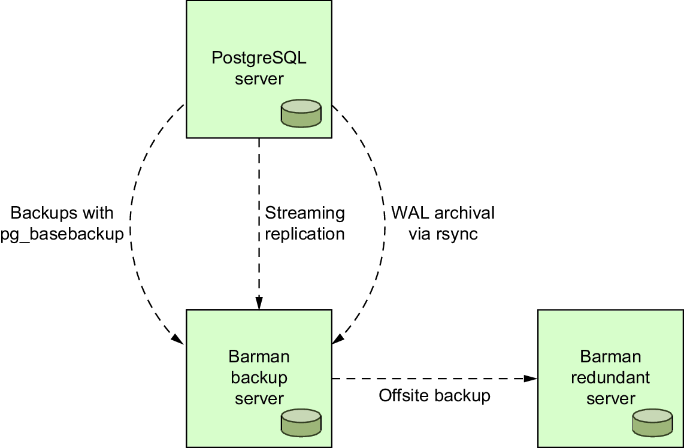
Use the architecture diagram to trace base-backup and WAL-transfer paths between PostgreSQL, Barman, and redundant storage locations. section 9.3
