Base64url encoding is a URL-safe variant of base64. It replaces + with - and / with _, then omits = padding, avoiding URL-sensitive characters and unnecessary percent encoding. section 7.2.2
A JWT applies base64url encoding to its header, payload, and signature, joining the three encoded parts with dots. The encoding changes representation; it does not itself provide signing or confidentiality. section 7.2.2
JWT representation
A JWT can appear as three URL-safe segments: an encoded JOSE header, an encoded payload containing claims, and an encoded signature. A certificate-bound token can also carry a base64url-encoded certificate thumbprint in the cnf.x5t#S256 claim. section 7.2.2 section 7.5.1
Figure 7.2 To produce a JWT, we base64url encode the header, payload, and signature, and we join them with dots as separators.
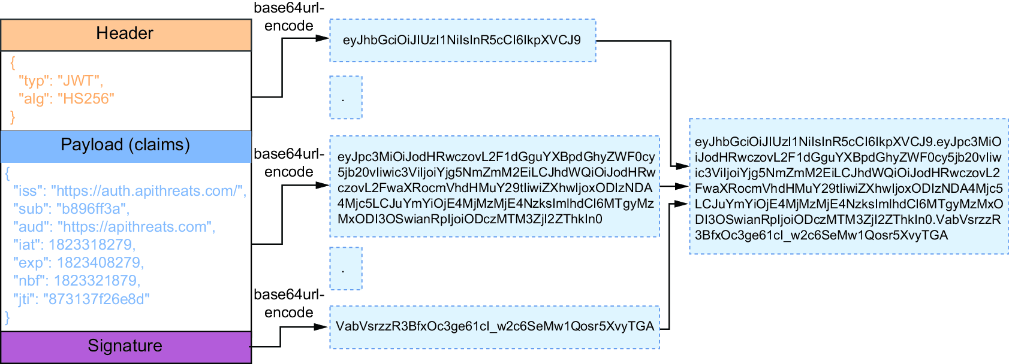
Shows how base64url-encoded JWT components are concatenated with dots to form a token. section 7.2.2
