Batch expected improvement scores several candidate evaluations jointly, favoring batches likely to improve on the incumbent while discouraging redundant, clustered queries. section 7.2.2
The batch perspective changes the acquisition decision in several ways:
- A batch containing nearby points can waste parallel evaluations because its queries provide similar information. section 7.2.2
- A preferred batch balances high predicted objective values with sufficient separation between queries. section 7.2.2
- The best batch need not contain the point selected by sequential expected improvement. section 7.2.2
Two-point toy objective
For a one-dimensional objective, batch EI selects the symmetric pair 1.68 and 2.12 rather than sequential EI's single point at 1.75. Their separation avoids placing both evaluations near the same location. section 7.2.2
Figure 7.14 A heatmap showing the acquisition scores of the batch EI policy for batches of size 2 with a one-dimensional objective function. The top and right panels show the observed data and the current GP belief about the objective function along the axes of the heatmap. The two optimal pairs of queries, denoted as the two stars, contain 1.68 and 2.12, which are relatively far away from each other.
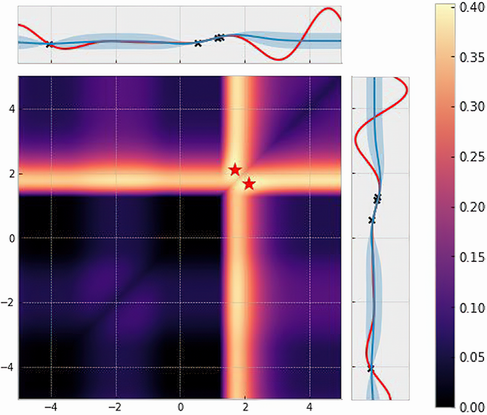
A heatmap makes joint batch scoring visible: the highest-scoring pair combines promising locations with meaningful separation. section 7.2.2
