liveBook · Manning

Bayesian model

As explained in Bayesian Optimization in Action

A Bayesian model represents uncertain quantities with probability distributions and updates beliefs using observed data and Bayes' theorem.

A Bayesian model represents uncertain beliefs with probability distributions and updates them when new observations arrive. The same evidence can produce different conclusions because people begin with different prior probabilities. section 3.1

The carnival psychic

Imagine a person correctly guessing a number from 0 to 9 one hundred times. For a true psychic, the likelihood of a correct guess is 1; without psychic ability, it is 1 out of 10. Each observer combines these likelihoods with a personal prior belief and updates to a posterior probability. A skeptical observer’s belief rises slowly, while someone who assigns a prior of 0 remains at 0. section 3.1

Figure 3.3 How each person’s prior belief is updated by the same data. Compared to Bob’s, your prior is much lower and increases more slowly. Alice’s prior is 0 and stays at 0 throughout.
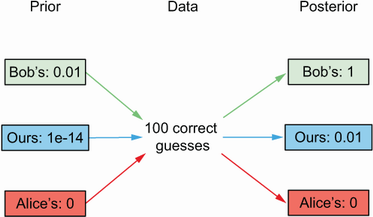
Compare how identical observations produce different posterior beliefs when the initial priors differ. section 3.1


How Bayesian Optimization in Action covers it

How deep it goes
Defines prior, likelihood, and posterior through a toy example while treating Bayes’ theorem only at a high level.
Examples
Uses a carnival psychic guessing secret digits one hundred times and compares three observers’ reactions.
What you can do after
Evaluate how prior beliefs influence posterior conclusions when multiple observers receive identical evidence.
How it connects
Connects prior probability, likelihood, posterior probability, and Bayes’ theorem.

Also explained in

Compare how 2 books explain Bayesian model →

Related concepts

This explainer was generated by Manning's knowledge graph from the text of Bayesian Optimization in Action. The section links point to the parts of the book it draws on.