Bayesian Truth Serum (BTS) scores subjective annotations by combining each annotator’s actual answer with predictions about how common each answer will be. It highlights responses that occur more often than annotators collectively expected; these can be informative even when they are not the most frequent answers. An information score is not a direct measure of annotator accuracy. section 9.1.4 section 9.10
Cyclist versus Pedestrian
In the example, Cameron scored highest because “Cyclist” appeared more often than expected, making the less-frequent label informative. Evan’s predictions were more accurate, but Cameron’s BTS score was higher. Blake scored lowest after predicting “Pedestrian” far more often than it appeared. section 9.1.4
Figure 9.6 BTS combines the person’s actual annotation with the predictions for expected annotations into a single score. Info is the information theoretic score (Expected × log(Actual / Expected)). The scores for each annotator show Cameron with the highest score. For both the expected and the actual annotations, the scores are based on information theory. The score is not only about the accuracy of each annotator; it is also about how much information each annotator is providing.
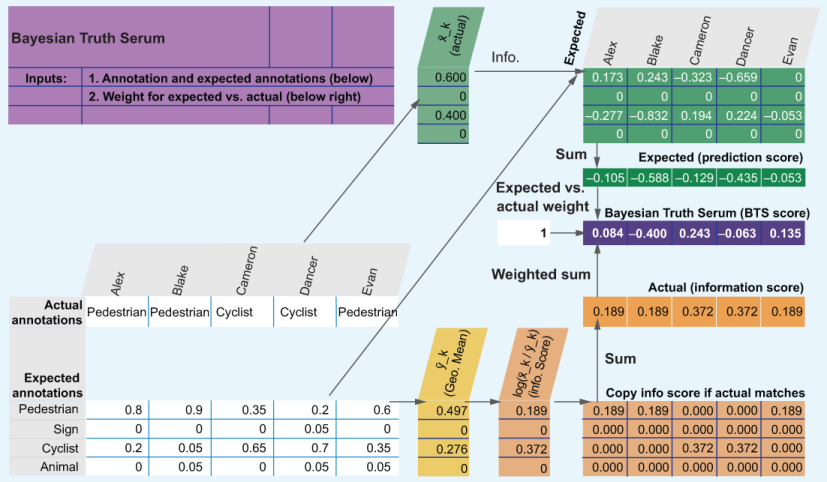
The figure shows how expected and actual annotation frequencies contribute to the information score, and compares the resulting annotator scores. section 9.1.4