liveBook · Manning

Behavior function

As explained in Akka in Action, Second Edition

A behavior function is a function that defines how an actor processes messages and determines its subsequent behavior.

A behavior function defines how an actor handles messages and what behavior follows. Because actors can be created or re-created from behavior functions and communicate through actor references, functional processing can be separated from fault recovery. section 5.1.1

This separation supports fault-tolerant design by keeping these concerns distinct:

  • Message-processing behavior remains independent of recovery handling. section 5.1.1
  • Actors can be suspended and restarted during fault recovery. section 5.1.1
  • Actor references avoid the direct object references that make components hard to isolate. section 5.1.1
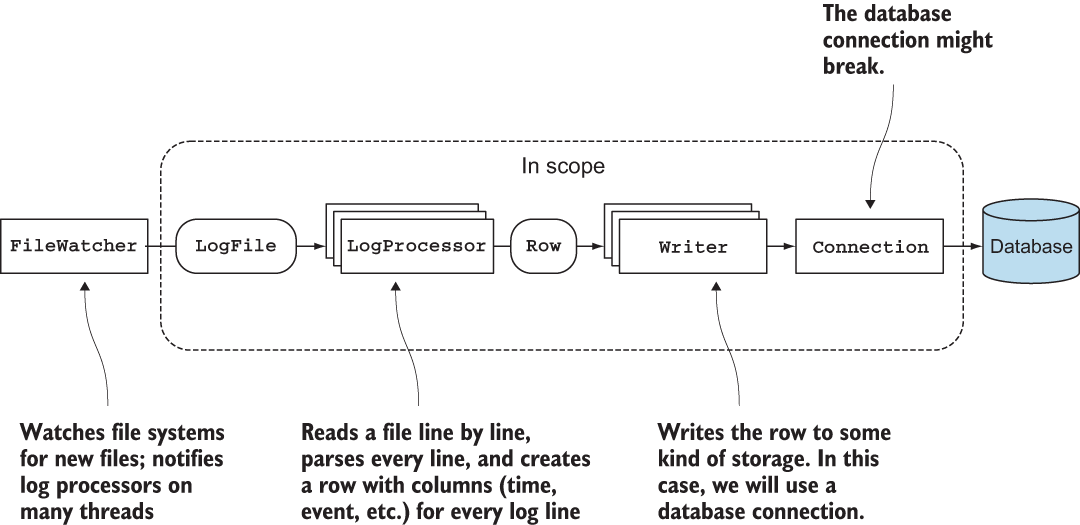
Figure 5.1 Processing logs from the FileWatcher, to the LogProcessor, to the Writer, and to the database
CH05_F01_Abraham2

Follow a log-processing flow from FileWatcher through LogProcessor and Writer to see independently communicating actor roles. section 5.1.1

How Akka in Action, Second Edition covers it

How deep it goes
Explains behavior functions through actor recreation, references, and lifecycle-based restart, without implementation details.
Examples
Illustrates a FileWatcher-to-LogProcessor-to-Writer log-processing pipeline.
What it assumes
Assumes familiarity with basic actor features before applying behavior functions to fault recovery.
What you can do after
Evaluate/understand how actor recreation and references isolate recovery from processing behavior.
How it connects
Connects behavior functions with actors, actor references, fault recovery, suspension, and restart.

This explainer was generated by Manning's knowledge graph from the text of Akka in Action, Second Edition. The section links point to the parts of the book it draws on.